
Why read this article? Launching a commercial website on a new domain in 2026 tends to bring out two extremes. One is the belief that you can rank in the top 3 in two months. The other is panic that AI has killed search. The data paints a more precise and useful picture. Traditional search remains the main source of enquiries. In a 2026 SE Ranking study of 101,574 sites, organic search generated 42.75% of all visits versus 0.32% from direct AI-chat referrals, a gap of about 134 times. Competing as a newcomer has become harder. Domains under two years old account for only 2.03% of Google's top 10, and the share of Alice AI sources outside Yandex's top 10 fell from 40% to 10%. Trying to speed things up with fake engagement or 2,000 AI-generated articles can lead to a site-wide ban of 8–12 months. This guide draws on official material from Google and Yandex, leaked code and API documentation, US antitrust court records, research from Pew Research, Ahrefs, SE Ranking, First Page Sage, SALT. agency, RocketData, Whitespark, HSE University's Institute for Statistical Studies and Economics of Knowledge, Ashmanov & Partners, and examples from Russia. It explains how the sandboxes work, why sites can get stuck for 90 days in their first week, what works in AI search and how much to budget for the first 12 months.
If you have 2 minutes, here are five takeaways and where to find the details:
* A 27-fold authority gap holds new sites back. In Google, sites over 15 years old have 27 times as many referring domains. The top 2% of new sites break through within the first few months by focusing on narrow topic clusters. See Chapter 1.
* The leak exposed Google's
hostAgesandbox signal, and Yandex uses a multi-armed bandit. Both systems treat sites with no history differently, which is why tactics developed for Western markets can fail in Russia. See Chapter 2.* AI search has split in two. Google AI Overviews, Perplexity and ChatGPT can link to new sites outside the top 10. Alice AI draws 90% of its sources from Yandex's top 10. New businesses can still show up through articles on VC.ru and Habr. See Chapter 3.
* A clear offer (+11.2 percentage points) and a clean launch beat technical workarounds. No bot requested 97% of the
llms.txtfiles billed as instructions for AI. A single launch error can stop Google indexing for 90 days. See Chapters 4 and 5.* Plan for a realistic timeline and budget. The first signs of progress show up in months 2–4, followed by a plateau in months 5–8. Consistent commercial enquiries arrive in months 6–18, and a realistic working budget in Russia is 45–150 thousand rubles per month. See Chapters 6, 7 and 8.
1. Search results in 2026: what makes it hard for new domains to rank and where they have an opening
The launch of a new site begins with the geography of demand. In the world, Google is unconditionally leading with a share 91,1% (Statcounter, August 2026; Bing - 4.5%, Yahoo! - 1.23%, Yandex - 0.99%). In Russia, the picture is mirrored: according to the annual report of Yandex for 2025 and measurements by StatCounter and Impulse. guru in spring-summer 2026, Yandex controls 69,3-73.3% of Russian search, And Google has 25-26%. Therefore, the attempt to promote the Russian site strictly on English-language manuals systematically underestimates Yandex’s commercial and behavioral requirements.
The second important reality of 2026 is the noticeable “aging” of the first page of the issue. Two large-scale studies - SE Ranking (slice) 100,000 US search results April 2026) and updated measurement Ahrefs (May 2025 of the year: 1 million random pages, 2 million cleared English pages and 1,3 million queries) - show how tightly entrenched age resources are:
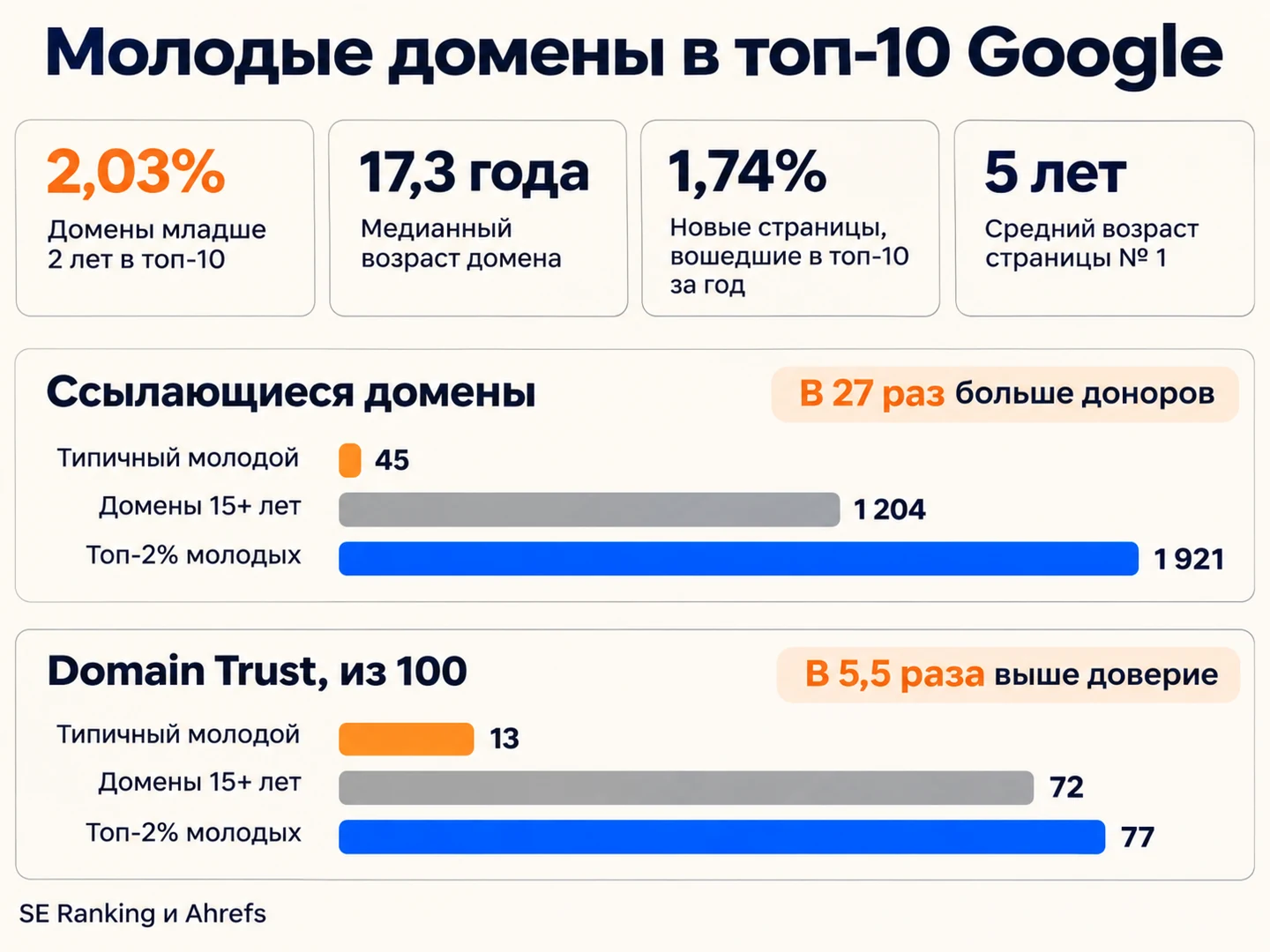
* Domains under 2 years old are only 2,03% of positions in the top 10 Google and all 1.42% in top 3.
* The median age of a domain on the first page of Google 17.3 years (in top 3 - 19.6 years The average age of a single page in the 1st place has increased from 2 years in 2017 to 5 years!
* Over the past eight years, the share of pages older than three years in the top 10 has increased from 59% to 72.9%, The percentage of pages under one year old is 22% to 13.7%. Among all random new URLs in the top 10 for the year makes 1,74% (or 6,11%, If you weed out blank and technical pages, Ahrefs himself considers 6.11% a more honest benchmark).
Why do old people dominate? Not because of the number in the certificate of domain registration, but because of the accumulated asset over the years. According to SE Ranking, domains older than 15 years (they occupy 57.15% of the top 10 and 62.61% of the top 3) in 128 times more backlinks (median 10,875 vs. 85 in a typical beginner under 2 years of age), in 27 times more referring domains (1 204 vs 45) and in 5.5 times higher domain trust index (72 vs. 13 on a scale of up to 100).
But in the same numbers hides the main chance of a beginner:
- Upper 2% of new domains, broke into the competitive top 10, in terms of trust (77) and the number of referring sites (1 921) overtake even 15-aged old residents - the search rewards not a calendar age, but quality and authority.
- In measurement Ahrefs Among those pages that still got in the top 10 for the first year, 40.82% did so in the first month after publication 94% of pages never make the top for most common searches.
- How exactly do beginners, brilliantly shows a fresh domain story. cv (Registered May 25, 2025) from the report SE Ranking: the site is already ranked by 668 requests, of which 75 (11%) entered the top 10. The secret is simple: the average competitiveness of these phrases was only KD 13 On the scale of difficulty (maximum 34), more than half (40 out of 75) have a demand below 100 impressions per month, and almost half of the victories (34 out of 75 keys) are gathered around a Small Thematic Cluster.
The conclusion for new business is clear: a head-on attack on broad phrases like “repair apartments” or “buy a laptop” at the start is almost doomed, but the point concentration on weakly closed narrow subtasks of customers brings the first page in the first months.
What does a “narrow cluster” look like in practice (three examples for Russian business):
Repair and construction:* instead of the battle for "renovation of apartments Moscow" - the starting cluster «repair of the bathroom turnkey in a new building with replacement of risers, estimates for work and for a period of 14 days» (separate page + calculator + analysis of waterproofing errors).
B2B production and equipment:* instead of "industrial machines to buy" - cluster «selection and commissioning of a fiber laser machine for cutting stainless steel 3-6 mm» with gas flow tables and calculation of payback.
Legal and consulting services:* instead of "legal services" - cluster «Recovery of a penalty from the developer on DDU in Moscow: calculation formula, documents and judicial practice 2026».

2. How does the “sandbox” in Google and Yandex: facts against myths
For more than twenty years, marketers have debated whether there is a “sandbox” (artificial quarantine for young sites) in fact. After the leak of part of Yandex source code (January 2023), the antitrust process of the US Department of Justice against Google (2023-2024) and the leak of internal documentation of Google Search Content Warehouse API (May 2024), myths and facts finally diverged.
Google: What the 2024 Leak Confirmed (and Where the SEO Market Exaggerates)
For years, Google’s official speakers (including John Mueller) have denied the hard “sandbox filter” and direct bonus for the domain age. But in 2020-2021, Mueller himself made an important caveat: when data about the young site is not yet available, algorithms evaluate it “approximately”. Because of this, the new resource can either start below its real potential (“sandbox effect”), or take off abruptly for a couple of weeks, and then roll back (“honeymoon effect”) while the system collects real signals.
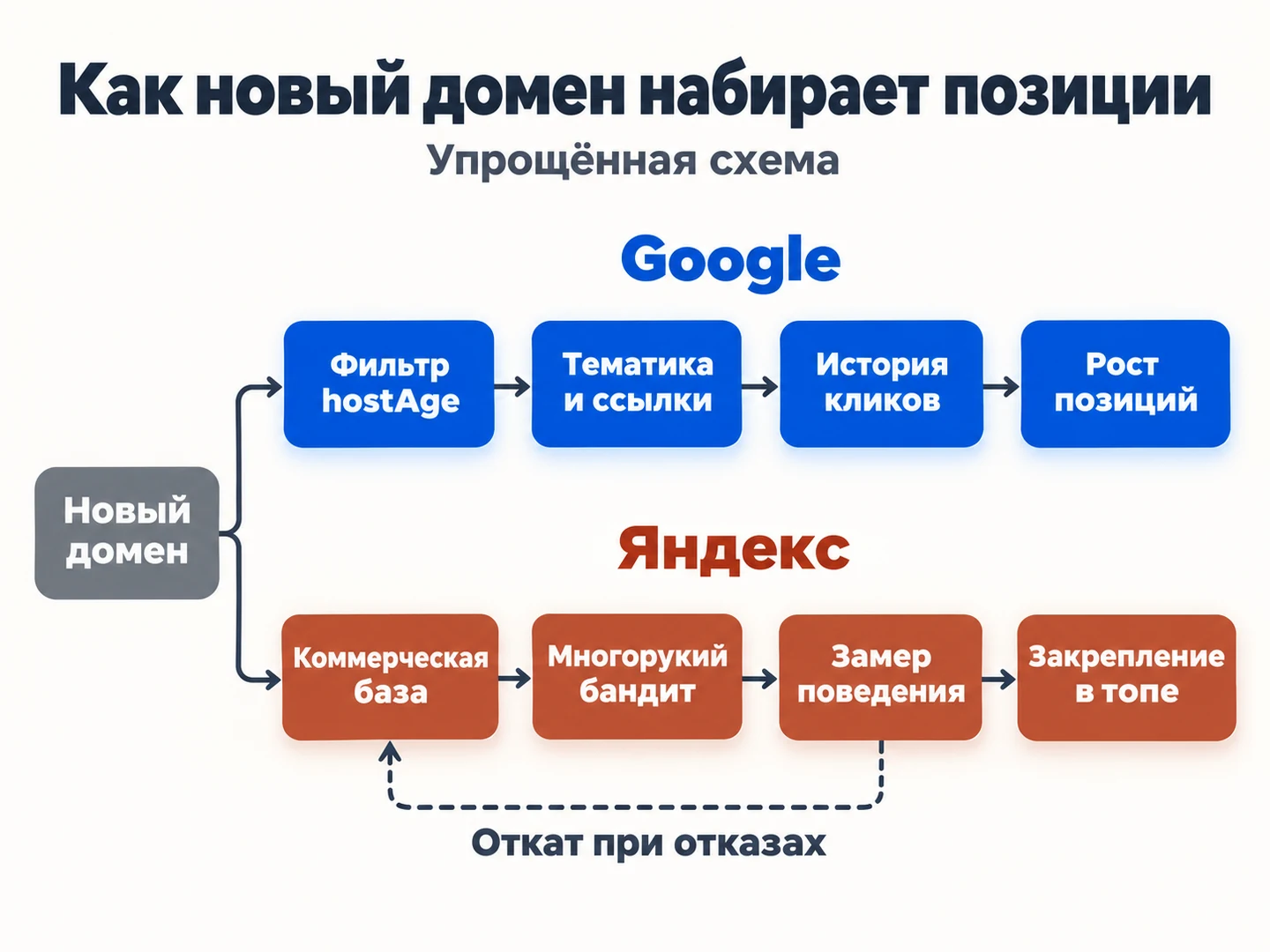
In the spring of 2024, an automatic bot yoshi-code-bot Google accidentally uploaded the internal documentation (2,596 modules and 14,014 parameters) to GitHub, which was disassembled on May 27 by Mike King (iPullRank) and Rand Fishkin (SparkToro), and on May 29 Google itself confirmed its authenticity (with the proviso that some of the data may be incomplete or outdated). Inside the module PerDocData the Parameter hostAge - the earliest date when the robot first saw the pages of the site. In the comments of the developers, its purpose is directly written: “used to isolate fresh spam at the time of issuance”.
But here it is important not to fall into the other extreme. The documentation itself does not disclose formulas and weights. According to analysts Search Engine Land, hostAge works not as a “youth tax”, but as a protective antispam safety. Honest new business in Google is holding back not so much this parameter, but the simultaneous absence of Four System Assets, confirmed by leaks and sworn testimony of engineers in a U. S. court:
- Zero Sitewide Authority ( NLSA
siteAuthority): internal assessment of trust in the entire domain, which Google has previously publicly denied. - No 13-month click history (
NavBoost): One of the strongest ranking systems Google, which accumulates statistics of successful and unsuccessful user transitions (who stayed on the site, who returned to search, what click was the last and longest). - There is no history of real visits from the Chrome browser: Google takes into account the actual attendance of the site by live people through the browser (
chromeInTotal,chrome_trans_clicks). - No clear thematic specialization is formed (
siteFocusScore,siteRadius): The algorithm needs to understand what exactly your site is about, how tightly all its pages hold on to one topic and whether you are trying to write “about everything”.
(There was a flag in the leak. smallPersonalSite to classify small sites and personal blogs, but its effect - lowering, raising or simple labeling - is not proven, so there is no reason to consider it a "fine against small business.")
Yandex: the lack of behavioral history and the algorithm “Multi-armed bandit”
In January 2023, fragments of the internal Yandex repository were leaked to the network. Arcadia, and revealed 1,922 ranking factors (Part is already obsolete or has been marked as disabled, but the overall architecture is visible crystal clear). The code confirmed the age of the site and document, the freshness of updates, the quality and subject of links, the reliability of the host, 7 separate factors for medical topics - and most importantly: The most powerful contour of behavioral and traffic signals. The algorithm looks at the proportion of direct visits ("green traffic"), user returns, bookmarks, a variety of sources (if 100% of visits come only from search without direct visits and social networks - this looks suspicious) and whether low-quality pages drag down the entire domain.
In 2026, the “sandbox” in Yandex is not a formal ban, but "Cold Start": behavioral signals (depth, duration, no returns to the issue) have become decisive, and the fresh site simply does not have them. The first 3-6 months Yandex evaluates it mainly on host reliability, texts and commercial completeness.
To break the vicious circle ("no positions -> no visitors -> nothing to measure"), Yandex runs an algorithm “The Many-Handed Bandit” (Multi-Armed Bandit - its mechanics Yandex analysts publicly described at the conference Optimization and on Habre). The algorithm periodically “switches” fresh relevant pages from the 2-4th page of the issue right up, measures the real reaction of people (reading whether they find the price, do not run back into the search) and according to the results of the test either fixes the site in the top 10 or rolls back.
An important technical fact and three debunked myths about age:
* Searches for age not from the date of purchase of a domain from the registrar, but from the date of first discovery and indexation of its pages! Domain, three years lying empty "in the parking lot", after launch behaves exactly like bought yesterday.
Popular myths in The Russian web - as if Yandex recalculates the age of sites exactly 1-3 January, “After 3 years, the age bonus stops growing” or Yandex has officially recognized that behavioral factors weigh 45%, and links 30%* - have no official confirmation. Neither Yandex nor Google have ever published the exact percentage weights of their formula.
| Option on start | Google (2026) | Yandex (2026) | Data reliability level |
|---|---|---|---|
| The Sandbox Mechanism | Anti-spam filter hostAge + zero domain authority and no 13-month click history NavBoost | Lack of behavioral statistics; the first 3-6 months. reliance on host reliability, texts and commercial factors | Confirmed by leaks (2023/2024), U. S. court and practice |
| Positions in 1-5 months. | Smooth acceleration; a short takeoff ("honeymoon") is possible with subsequent rollback | Sharp “swing” due to test throws of the algorithm “Multi-armed bandit” | Confirmed by Google speakers and Yandex publications |
| Main output accelerator | Narrow thematic clusters, brand awareness and quality thematic links (30-50+ donors for competitive niches) | Full commercial base on the site, Yandex Business card, retention on the 1st screen and traffic from different channels | Consensus of leaks, research and agency cases |
| Primary indexing | Usually 1-4 weeks for small site; high risk of hanging out of index when startup errors | Accelerated through site map, protocol IndexNow and official "Round Meter Meters" | Confirmed by official documentation and cases |
| Sensitivity to pauses | Average but large kernel updates are released approximately once every 90-110 days (median 109.5 days for 2021-2026). | High: young sites without accumulated inertia quickly subside when stopping work | Google Calendar and Practitioners Observations |
3. AI search and young sites in 2026: three unexpected conclusions
In February 2024, analysts Gartner The market was frightened by the forecast that by 2026, the volume of ordinary search will collapse by 25% due to the departure of people in AI chat rooms. By the end of 2026, the figures showed a different picture: the volume of search queries almost did not fall (according to the study Impulse. guru According to Similarweb, Google’s global traffic has declined by only a year. 0,89%, Yandex’s share in Russia has increased 2,6 percentage points). But The share of transitions to the sites themselves has sharply decreased: panel SEOcrawl 16 661 sites recorded a drop in organic clicks on Google 15% (in the median site on -20,1%), and Growth Memo - Fall of visits to 13,2% in the United States and 24,4% in France (among infomedia - more than 40%).
The reason is obvious: generative responses moved directly to the first line of the search engines themselves.Google AI Overviews / AI Mode and Yandex "Search with Alice AI"). For a young site, this follows Three Critical Conclusions.
Conclusion 1. Direct traffic from AI chats is still small, but “search without a click” has already taken half of the information transitions
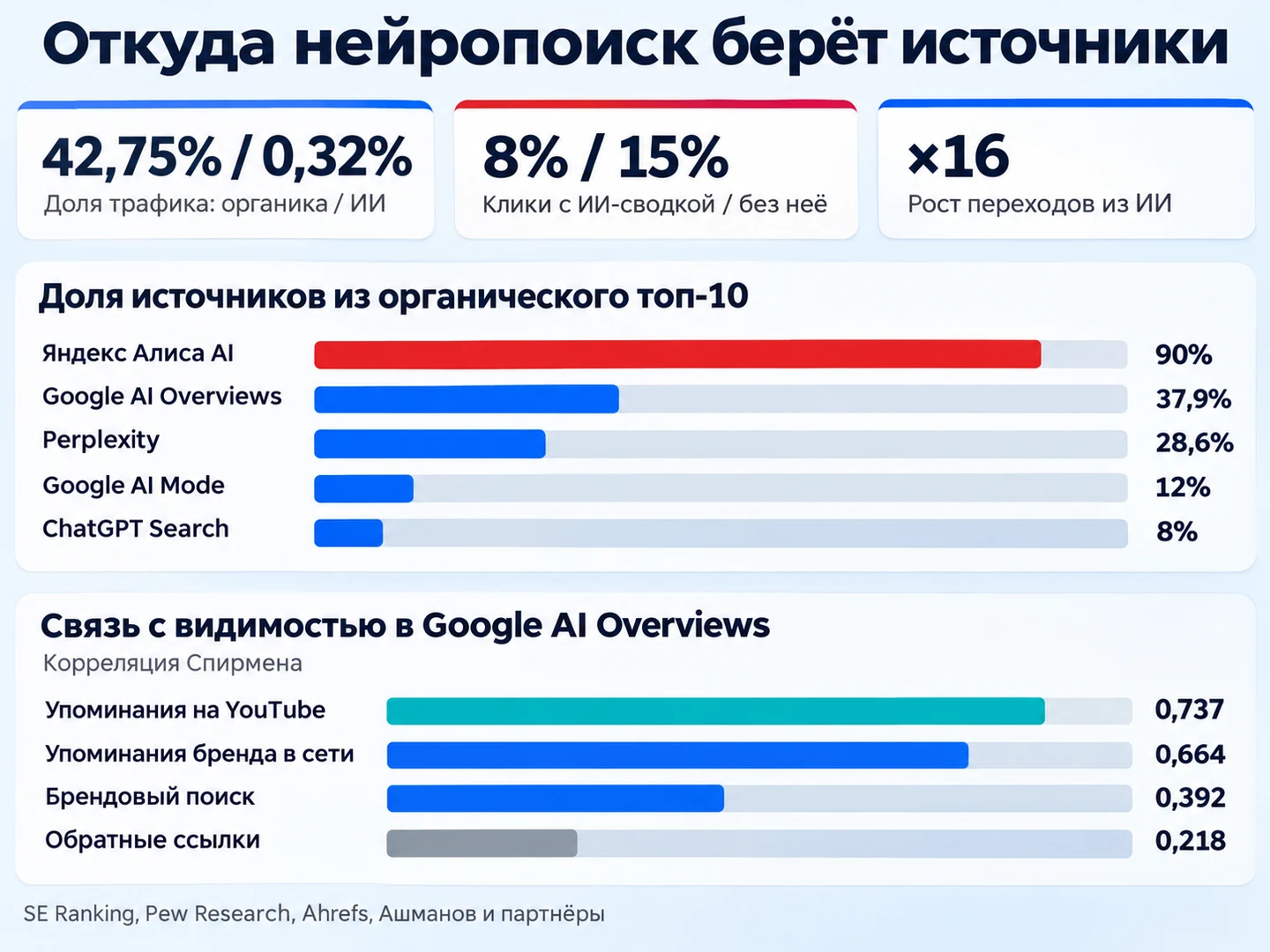
According to SE Ranking* (101,574 sites, early 2026), direct transitions from all AI platforms have grown in two years 16 times (from 0.02% to 0,32%), but it is still about one visit out of 312 against 42,75% in the classic search (in large US corporations, by benchmark Conductor, The share above - 1,08%, of which 87.4% is given by ChatGPT).
* Important reservation about Russia: The sensational report of the end of 2025, where Alice allegedly had only 0.2% of traffic, distorted the picture due to measurement only on computers and without taking into account Alice's built-in block in Search. Impulse. guru (June 2026, 3,000 users) corrected the technique and showed that Alice AI brings almost 5 times more traffic to sites than ChatGPT. According to official data of Yandex, Alice's quick answers in Search are used 46.5 million people per month (April 2026), and in her chat - 30.5 million authorized users. According to the survey HSE ISSEZ (Summer 2026, 6,236 Russians), 79% have applied to AI in the last 3 months, 24% They use it every day, and 52% They are already instructing AI systems to search for information.
* Clickability Impact (CTR): Independent measurement Pew Research Center 68,879 real requests) proved that when there is an AI summary over the issue, people click on ordinary links only in the 8% of visits Against 15% without it (and by the links within the summary - all in 1% and often close the browser immediately (26% Against 16%). By measurement Ahrefs (300,000 queries), the drop in the share of clicks on the 1st place Google in the presence of AI-summary deepened with -34,5% the Spring of 2025 -58% by the beginning of 2026. In Russia (Kokoc Performance, November 2026) information sites lost 15-60% Business blogs are often not included. 25% traffic after the April update of Alice, even remaining in the TOP-5.
Conclusion 2. Western AI systems opened the “side entrance” to young sites, and Yandex Alice closed it without top 10
This is the main strategic divergence of 2026, about which almost no one warns the owners of Russian sites:
* In Google AI Overviews, ChatGPT and Perplexity, a young site can get in response before reaching the top 10.
Google has a huge question engine.Query Fan-Out): neural network breaks a complex question of a person into a dozen clarifying sub-queries and tightens the answers from their outputs. By measurement Ahrefs (March 2026, 863,000 hits and 4 million citations), the share of links from the top 10 on the original query in Google AI Reviews fell by half in eight months - with 76,1% the City 37,9%, and 62,1% quotes came from positions 11-100 and even from outside the first hundred! In Google AI Mode, the share of top 10 was total 12%, in Perplexity - 28,6% (Perplexity can quote a new page within hours of indexing!) and ChatGPT Search can cite a new page. 8% (About 90% of ChatGPT quotes are at 21+ positions in Google, as it relies heavily on the search engine database Bing - 87% match with TOP-20 Bing by measurement Seer Interactive).
In addition, AI systems love freshness: by measurement Ahrefs (17 million citations) cited by AI pages on average for 25.7% fresh Google Organic top 10 (1,064 days vs 1,432 days) The popular story “fresh content cited 4.3 times more often” has no confirmed research). In practice, it already works: the owner of a new domain deutschwunder.com (launched in July) 2025 years) recorded that while the site was in the "sandbox" of Google with200 Visits per month, About 30% of all traffic to it has already brought ChatGPT!
* In Yandex Search with “Alice AI” the path without the classic top 10 closed.
As described by the engineers of Yandex itself on Habra, the neural network compresses the dialogue into a search query, turns to the main search (in 60% of chat answers), slices the found pages into short semantic pieces of about 256 tokens (about 150-200 words), takes no more than 5 best documents and collects an answer. Measured by laboratory "Ashmanov & Partners", from August 2025 to January 2026 The share of sources outside the organic top 10 in Alice’s answers fell from 40% to 10% (90% of links are strictly from the top ten!) and the update of April 7, 2026 even more rigidly consolidated the selection of quality primary sources according to the standard EPOS (Expertise, Utility, Originality, Content). In Kurt Fishman's test (730 quotes from 75 commercial queries) 1st place gave citation in 43% 7th and all the answers 5%.
(Popular in The Russian web rumor that to get into Alice supposedly needs the threshold of X > 50 - Site quality index, - not officially confirmed: 27 February 2026 Yandex updated the formula of X and once again stressed that X does not affect the ranking.)
Conclusion 3. Commercial applications in the Russian Federation are protected from “search without a click” better than information, and the AI visitor buys significantly more often
By measurement Kokoc Performance* (September 2026), in Russia AI answers close to 80% of information (How to choose...), but only 5% of direct commercial queries (in the test) Sostav In Moscow on the desktop block “Fast response of Alice AI” appeared 0 times out of 20 in selling phrases). In Google USA, the commercial scope of AI is already much wider (by measurements Ahrefs and Semrush In autumn 2026 - 73-83% of branded and up to 88% of commercial-modifier requests), so in The Russian web business still has a window ahead of the market.
At the same time, the visitor who still came from the recommendation of AI comes as “warmed up” as possible: according to Adobe Analytics* (July 2026), retail traffic from AI is converted to 60% higher than normal; by measurement Similarweb - 11,4% the ChatGPT 5,3% from a regular search; and according to Seer Interactive, brands that are included in the quote of AI-summary, receive on 35% more organic clicks the National Museum of Art 91% more clicks on their ads.
Finally, a great study Ahrefs* the National 75 000 brands showed: Brand mentions on YouTube (Spirman correlation coefficient) 0,737, where 1.0 is full communication and 0 is no communication) and References in web articles (0,664) related to getting into Google AI Overviews Three times stronger than classic backlinks (0,218). But it is important to soberly clarify the Ahrefs and meta-analysis BrandMentions (410,000 mentions): This link is strong in Google AI Overviews0,65) but weak in Perplexity (0,30) and is almost invisible in ChatGPT (0,15), and most importantly - Correlation is not a direct cause, and the artificial cheating of fake mentions is expressly prohibited by Google’s spam policy of May 15, 2026.
4. Seven working levers: what really speeds up indexing and applications of a young site (and what you can not spend money on)
In the first 90-180 days, the task of the owner of a fresh domain is not to look for “secret loopholes”, but to remove technical barriers, quickly show search engines narrow specialization and commercial reliability, and also “rent trust” at sites that are already trusted by search and AI systems.
4.1. Technical hygiene and “first impression trap” for 90 days
Few people know, but One technical negligence in the first week after opening a site can freeze its indexing in Google for a whole quarter. This brilliantly proved the real case Telstar Consulting (September 2026): A new WordPress site (18 pages) launched on June 16, 2026, but in the first 10 days it was turned off by a page-stub "Site on development", an accidental speed limit crawl-delay: 10, A one-day mistake 404 on the site map, blocking by hosting protection (code 429) and a three-hour random indexing prohibition tag noindex.
After fixing all the errors, Bing quietly indexed the site in a few days - and Google’s 8 main commercial pages are stuck in the status “Discovered, not indexed” for exactly 90 days! The Circumstances Report Crawl Stats Google Search Console found that the main robot Googlebot stopped visiting these addresses at all - neither text correspondence, acceleration, nor 90 new internal links helped. Only a radical measure saved: the transfer of pages to new clean addresses with a server 301-redirect, after which all 8 pages flew into the index for 36 hours!
Mandatory technical checklist of the launch day (to do BEFORE opening the site to robots):
- Perfectly clean start: remove any stubs, tags
noindex, limitationscrawl-delay. Extra redirect chains and aggressive hosting/CDN (content delivery network) protection, make sure all work pages give code200 OK. - Connect three webmaster panels at once:
* Yandex Webmaster - be sure to include official "Round by Yandex Metrica meters" and Instant Alert Protocol IndexNow (works directly on Yandex and Bing);
* Google Search Console - send a clean card sitemap.xml (working canonical pages only) and manually request indexing of the main pages;
* Bing Webmaster Tools - one hour of setup opens a direct path to the search database ChatGPT Search!
- Check access for search AI robots (short TK to programmer for 2 minutes): the Research Council OtterlyAI (More than 1 million quotes) 73% of sites accidentally block AI robots (often standard Cloudflare filters cut
OAI-SearchBotandPerplexityBot). Ask the developer to checkrobots.txtand server protection by simple rule:
* Definitely open (200 OKwithout nosnippet): Search Robots Googlebot, Yandex, OAI-SearchBot (ChatGPT search) and PerplexityBot.
* Can be closed at the request of the owner: Robots for Training AI systemsGPTBot, Google-Extended) - their closure does not prevent getting into live search answers.
- Give the text directly in pure HTML (server rendering, SSR): sites collected entirely on client JavaScript (naked React/Vue/Angular without server generation), are still unreliable read by both Yandex and AI bots.
From the practice of RM Systems: Almost every second new commercial site, which is brought to us “six months after launch without a single visit from Google”, suffered precisely from the dirty start – the developers opened a test version with half-empty pages, then closed for a week in the first place.
noindex, And then I wondered why the robots bypassed the site. On RM Systems projects we collect new sites on the Astro static engine (clean HTML immediately from the server without heavy JavaScript), test them on a password-closed stand and display them on the combat domain completely ready - on the first day connecting Yandex Webmaster with a bypass of the Metrics,IndexNow, Google Search Console and Bing Webmaster Tools.
4.2. Architecture of “Hub + spokes”, linking and Yandex commercial minimum
The structure of the young site forms its thematic focus and helps robots not to lose important pages:
* Model "Hub and spokes" (depth no more than 3 clicks from the main): the main page leads to key sections-hubs (services or categories), and those - to specific landing and expert analyses. According to a study of 23 billion internal links (Zyppy and Ahrefs Pages with 40+ internal links are collected before 4 times more traffic (while 66.2% of pages on the web have only one link), bringing order to the structure raises the completeness of crawling robots with 40% to 70% (JetOctopus), and the two-way link within the cluster increases the chance of AI citation in 2.7 times (Wells and Yext). Important reservation Zyppy for beginners: on the young site, it is not through links in the basement that work best, but meaningful contextual links right inside the text between related pages.
* The “one service/scenario – one page” rule: the Ranking Whitespark 2026 dedicated page for each service 1st place among local organic factors and 2nd place for visibility in AI systems. But do not split the site into dozens of clones under synonyms: according to Ahrefs, One strong page in the top 10 collects on average almost 1,000 related phrases, and 96,55% extra blank pages on the Internet do not receive traffic at all. Immediately lay short understandable addresses in lowercase letters without unnecessary nesting levels and numbers (in the Yandex leak this is fixed as a clear minus).
* Mandatory commercial base for Yandex: commercial factors in Yandex weigh more than the texts themselves! A young site from the first day should have: real prices or fork with explanation of calculation, availability status, clickable phones, instant messengers and physical address, details (INN, OGRN, legal address), transparent terms of delivery, payment and return (no “check price by phone”), online chat and basket/application form without forced registration.
The Anticafe of 2026: Russian online store Nike sneakers quietly stood in Top 5 Google, but failed at 32nd place in Yandex precisely because of the basket only by registration, an empty Yandex Business card and weak brand demand!
4.3. Speed and Core Web Vitalis: where is the real benefit, and where is the waste of weeks
Google's download speed and convenience Core Web Vitals In 2026, they have constant thresholds (according to real visits of Chrome browser users):
* The main screen loads in 2.5 seconds (LCP <= 2,5 s);
* buttons and filters respond instantly, faster than 200 millisecondsINP <= 200 ms);
* The finger does not jump when scrolling.CLS <= 0,1).
For a young site, there is an important nuance: the first months of Google Search Console will show the status of “Insufficient data” (visits with iPhone / Safari do not fall into Chrome measurements at all), and while there is little data, these metrics do not directly affect rankings. Moreover, chasing for weeks for "green 100 points" in the Lighthouse laboratory test is meaningless Laboratory numbers are not involved in the test.
Why is the speed still critical at the start? For two practical reasons:
- Google says that speeding up your downloads from 3 seconds to 1 second will boost conversions. +27%, With the mobile search percentage above 65% Slow website will fail the first test pods "Multi-armed bandit" in Yandex.
- Slow Time of the Server 's First Response
TTFB) causes search robots to slow down the crawl, delaying the indexing of new pages.
The correct standard is simple: once make a quick template on a good hosting, set the size of pictures against the layout jumps, remove unnecessary heavy scripts and personally open a website from an average Android smartphone on the mobile Internet, checking how many seconds the price and the order button appear.
4.4. Content, E-E-A-T and EPOS standards, and the exposure of “GEO promotion” myths
In the wake of interest in AI systems in 2025-2026, many agencies began to sell “GEO-optimization packages”: file installation llms.txt (text cheat sheet for bots at the root of the site) and advanced code micro-markup JSON-LD / Schema.org as the alleged main key to ChatGPT and Alice. In summer-autumn 2026, three largest controlled studies - Ahrefs (137,210 domains per llms.txt and experiment 1,885 vs. 4,000 pages on Schema) and First Page Sage (1,089 brands, 4,213 commercial prompts and 657 AI agents tasks) - put everything in place:
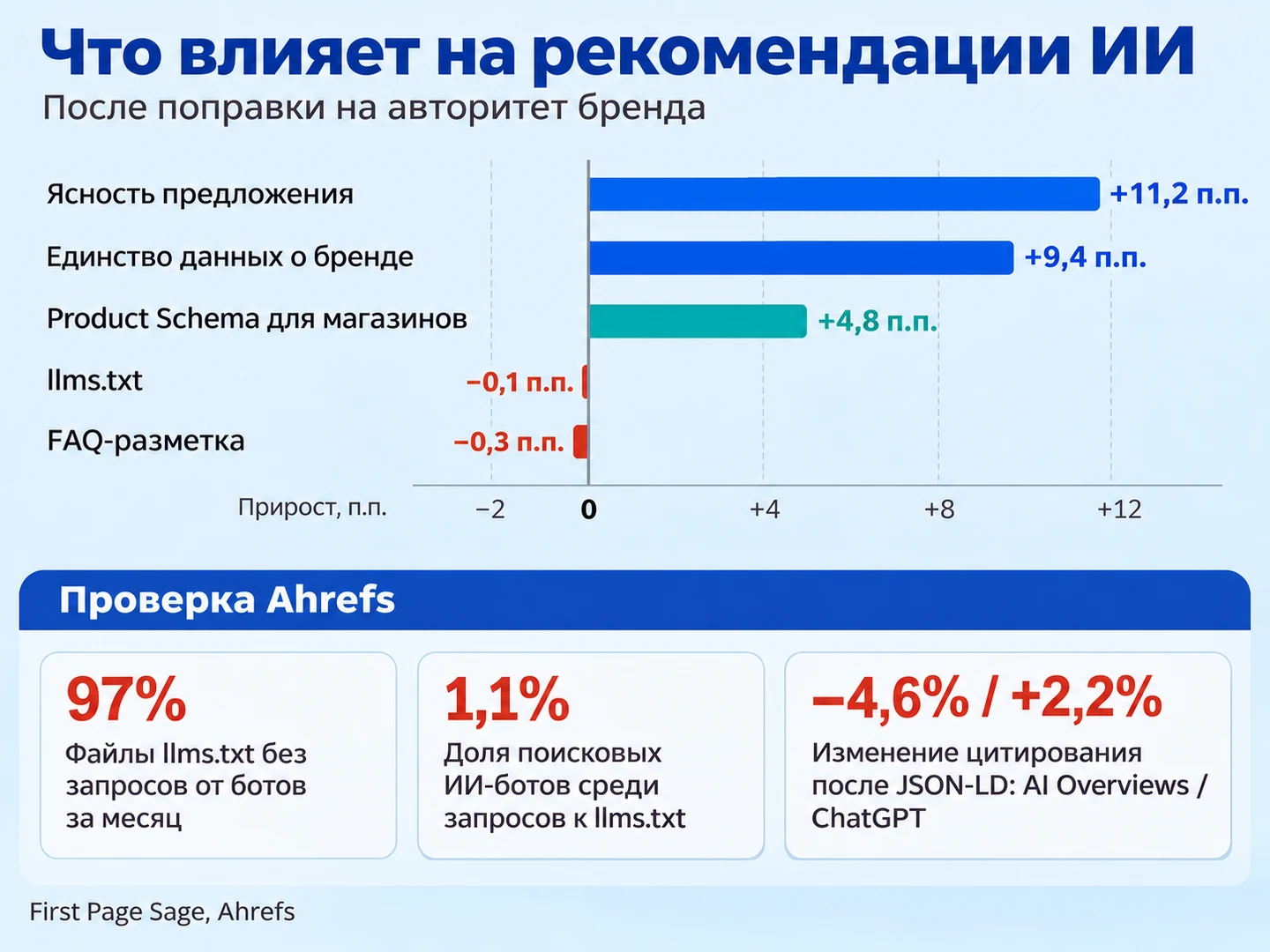
* File llms.txt Pure Myth: 97% Of the 38,360 published files received in a month, Google officially called the file unnecessary, and its net effect on AI recommendations was -0,1 pp (zero).
* General micro-markup Schema.org and FAQ They don’t have magic in them. As soon as First Page Sage leveled the sites by real brand authority, net gain from any total markup fell from +3.7 to +0,4 pp, from Organization - before +0,2 pp, and from marking of frequent questions FAQ - before -0,3 pp (Additionally, on May 7, 2026, Google finally disabled the extended FAQ blocks in the issuance). In a controlled test Ahrefs The micro-marking also remained at the level of statistical noise.
* What really gave a measurable increase in AI responses (after adjusting for authority):
- Clarity of the proposal and target audience (
+11,2 pp): companies with a clear, specific description of the service, audience and prices (rating 7-8 out of 10) were included in the recommendations of AI 23.6% of cases Against 2,1% The site with blurred slogans about "individual approach and innovation"! - Unity of company data across the network
+9,4 pp): Matching names, services, addresses, prices and facts on the site, in maps, directories and articles. - Micromarketing
Product / Offer / Reviewfor online stores (+4,8 pp): machine readable prices, availability and order conditions are almost Doubled getting goods into the choice of autonomous AI agents - with 19.4% to 36.8%!
The result of micromarkup without contradictions: do not pay for it as a "secret key to ChatGPT", but once at startup, put a net base Schema.org (Organization / LocalBusiness, BreadcrumbList, Article) for a beautiful display in the classic Yandex and Google - and if you have an online store, be sure to set up product markup Product / Offer / Review, which really works in both search and AI agents.
Three rules for young site content in 2026:
- The answer is “answer-first”: An analysis of 1.2 million responses to ChatGPT (Kevin Indig, 18,012 citations) showed that 44.2% of quotes are extracted from the first 30% of the text, Yandex Neuro cuts the text into meaningful pieces of 150-200 words. Make the main conclusion, numbers and price in the first 40-60 words of the section.
There was (clarity 2/10 - chance of AI recommendation 2.1%):* “We are a dynamically developing company with an individual approach. Experienced specialists will select the optimal solution for your facility. Quality guarantee, call for calculation!”
It became (clarity 8/10 - chance of recommendation AI 23.6%):* “Installation of supply and exhaust ventilation for cafes, offices and workshops in Moscow and turnkey MO: project for 3 days, installation for 5-10 days, cost from 4 200 RUB / m² with equipment and a guarantee of 3 years under the contract. Free check-out of the engineer with noise measurement and estimate in 24 hours.
- Standards E-E-A-T (Experience, Expertise, Authority, Trust in Google) and EPOS (Yandex): On April 7, 2026, Yandex officially fixed four criteria of the primary source - Expertise, Utility, Originality, Content. Betting on materials of real authors with experience, your own calculations, photos and figures. In a famous Princeton University experiment (ACM KDD 2024), adding statistics, citations and links to primary sources increased visibility in early AI responses by up to +40%, while keyword stuffing did not work.
- Focus on the bottom funnel (BOFU) and smooth pace: General articles "what is metal" takes the neuro response without a click. It is more profitable for a young site to make commercial landings, calculators of calculation, cost analysis, comparison of options and answers to the fears of the buyer from the first month - and release them stably (1-2 strong material per week; orientation HubSpot - 6-8 posts/month for an active blog and 2-4 for complex expert niches). And never change the date of the article "for freshness" without real text processing - Google (
lastSignificantUpdateYandex easily catches such fakes.

4.5. Primary advertising (Yandex Direct and Google Ads): how it really helps young SEO
There is no direct rule “paid Direct – up in organic search”: both systems strictly separate advertising and organic (as there is no official influence of Direct on the choice of sources by Alice AI).
But the launch of point advertising on hot commercial queries in the first 1-6 months of the new site gives Three powerful strategic advantages:
- Money from the first week, that feed the business while SEO goes through a startup run.
- Rapid exploration of demand and formulations: In 3-4 weeks you will know exactly what phrases and promises in the title bring real payments, and put them into the structure of the site instead of a half-year blind work.
- Legitimate Indirect Impulse for SEO: People remember the company name, search for a brand in search, return directly and leave useful behavioral signals (and brand demand, direct visits and a variety of sources directly appear in Yandex and Google leaks). In the Russian B2B case of an engineering company from St. Petersburg, the launch of Direct from the first month helped to quickly accumulate behavioral statistics and get the first free applications from search already on the 4th month!
The main safety rule: Never place paid ads on “raw” or slow pages with a high bounce rate and strictly mark up UTM ads so that when you pause in Direct, you don’t confuse stopping paid traffic with falling SEO.
4.6. Geoservices (Yandex Maps, 2GIS, Google Maps): the fastest legal bypass of the “sandbox”
If a business has a real office, clinic, salon, warehouse or local reception point, geoservices in 2026 are the shortest legal way to first applications bypassing the six-month waiting period of the site:
By research RocketData* (266,712 business locations In Russia, the audience of cards is divided almost equally: Yandex Maps - 34%, Google Maps - 33%, 2GIS - 33% (In Kazakhstan, 2GIS leads with 73%, in Belarus - Google Maps with 69%). Companies with active cards on all three platforms receive 1.5 times more traffic on average. than presented in only two!
In Yandex, the card and the site are evaluated as a single trust contour: discrepancies in address, phone, work schedule or prices hit positions and prevent AI from getting into Alice, and reviews from Maps directly participate in the rating of online stores. By measurement White Pattern according to Moscow clinics (September 2026), when recommending AI systems were primarily based on profile aggregators and maps (ProDoctors, Yandex Maps, 2GIS). (Important: Yandex Business paid subscription gives priority in Maps and Search, but is not a direct factor in the organic SEO of the domain itself.)*
In Google, according to a survey of 47 experts Whitespark 2026*Company Profile Signals 32% influence in the block of cards, and the weight of reviews increased with 16% to 20%. Among the main factors for 2026: Is the business open right in the minute of search (positions start to sit down at the last hour of work!) visible physical address and a filled list of services. 74% Customers are looking at the freshness of reviews for the past 3 months, and about 80% companies that respond to each review.
Here is what you can save: Controlled 9-week agency test Sterling Sky* (441 requests) proved Zero influence of Google Business Profile posts on positions (they work only on conversion), and the paid service of "prescribing geocoordinates to photo metadata" (geotagging) does not give any effect at all.
4.7. “Trust lease” on external sites and secure link building
While your new domain is saving its own weight, in 2026 you can legally rely on sites that Yandex, Google and AI systems already trust to the maximum:
In the factor model First Page Sage* (October 2026) 80.4% of the impact on recommendations in AI search is due to external authority signals, And in the first place with a breakaway - references in independent ratings and collections (33.1%). Moreover, the accuracy and coincidence of facts about your company on other people's sites weigh more (17,1% than the ideal order only on its own website)13,7%).
In the The Russian web, according to brandfound* (February 2026), 50% of the most cited resources are user and expert article sites (UGC): Habr, VC.ru, Zen, TenChat and YouTube. In a live experiment Head Promo expert publication on VC.ru came in response Alice AI in 15 minutes (the usual window for Habra and VC.ru - 1-3 days against weeks and months of waiting on a young site)! In global Google, the same role plays YouTube - he's got to. 18,2% all quotes in AI Overviews outside the TOP 100 and 24,5% the 50 Most Cited Domains in the United StatesAhrefs Brand Radar(November 2026).
* The most important step of the first 90 days: Run 20-30 real questions from your customers through Alice AI, Google AI Overviews, ChatGPT and Perplexity, write down the rankings, directories and articles they already quote, and arrange for your company to appear in those sources with the same verifiable facts.
* Secure backlinks (for Google and Yandex competitive niches): the Practical Guidelines of Link Building AgenciesWorldreach, iMark Infotech), the new domain starts with profiles, maps, directories and 3-10 quality theme sites per month with smooth growth (a sharp jump on 100+ links per week is a direct signal for anti-spam verification). In the texts of links (an anchor list) they keep a natural balance: 40-60% with the brand name, 20-30% naked address or "here / more details", 10-20% with partial mention of the service and not more than 1-5% exact commercial phrases. According to statistics BlueTree Digital (4 200+ editorial publications), a link from the profile site with live traffic and a high domain authority rating (DR 50+ on the Ahrefs scale) gives 2.8 times more growth, than a random donor. And their own mini-research, calculators and open data are collected in 3.2 times more natural links, than the usual advice.
The contrast: two young commercial sites in the first 90 days
| Launch phase | Typical problem start (stuck for 6-9 months) | System start 2026 (first applications in 2-4th month) |
|---|---|---|
| Release Day | Opened a half-empty site with plugs, forgot noindex for 2 days, did not connect Bing and bypass the metric -> 90 days outside of Google index | Clean release on fast HTML without 404/429 errors; on the day of launch, Webmaster (+ Metrics and IndexNow GSC and Bing Webmaster Tools |
| Structure and requests | One common page of “Services” and an attempt to immediately fight for “renovation of apartments Moscow” against 15-year-old giants | Narrow cluster "Hub + spokes": per page for each specific service + 5-10 price analyses and comparison of options with low competition |
| Commercial base | "Check the price by phone", there are no details TIN / OGRN, the form asks for registration -> failure of tests "Multi-armed bandit" in Yandex | Transparent price fork with calculator, TIN/OGRN, warranty conditions, live chat and instant payment without registration |
| Content and AI | Bought the installation llms.txt for 40 000 RUB and flooded 100 template articles from the neural network | Clear offer in the first 50 words of each page (Answer-First), real expert author, clean markup Product for goods |
| External trust | Sitting and 6 months waiting for a miracle from the site alone | Yandex Maps + 2GIS + Google Maps (1.5x traffic), hot demand point Direct launched, 3 cases on VC.ru/Habre and profile ratings were released |
From the practice of RM Systems: One of the main reasons for kickbacks of a young site in Yandex after test pods "Multi-armed bandit" - a person comes from the phone, does not find an understandable price for 10 seconds and returns to search. When we put an honest cost fork and a short calculator or a smart consultant in Telegram and MAX on the first screen of the commercial page, which counts the preliminary estimate and transfers the application to CRM in 15 seconds, the depth of viewing and retention increases from the first month - and Yandex algorithms fix the young site in the issuance much faster.
5. Five gray schemes and “harmful tips” that can permanently damage the reputation of a new domain
In 2025-2026, the price of gray experiments increased significantly. Google accelerated spam sweeps fourfold: in 2026 alone, they passed Four Global Anti-Spam Updates (in March, June, August and September-October) against one for the whole 2025, and in the fall of 2026 there was a wave of manual sanctions. Yandex March 28, 2025 officially reported that it has brought the accuracy of detecting low-quality and spammy pages to 99%.
Here are the five most dangerous practices that new website owners regularly sell under the guise of “speeding up the exit from the sandbox”:
1. Cheating behavioral factors (PF) in Yandex
Offers of the form "bring a young site to the top 3 Yandex in 2-4 weeks" using bots or exchanges for paid jobs look tempting, but the economy and risks are killer here:
* Yandex officially classifies any bot clicks and transition jobs as “Imitation of user actions” with the imposition of a host restriction (a fine on the entire domain, not on one page). According to the assessment Pixel Plus, over 95% of cheats Yandex catches directly on its own issue by device profiles, geography and brand demand anomalies - even if the site does not have Yandex Metrica at all.
In SEO environment, the enhancement of anti-fraud 2025 is often called the “typhoon algorithm” (Yandex did not officially confirm this name, reporting on the update of quality algorithms on March 28, 2025). By parsing Rush Agency*Cheap server proxies are dead since 2022, and the “premium” cheat through the farms of real smartphones is worth it from 100 000 RUB / month (more expensive than normal white SEO!), still flies every 3-6 months with a new turn of antifraud, and competitors massively collect the addresses of bots and send complaints to antispam.
* When hit by a host filter, they fall All site requests together: In practice, the ban is 8 months and longer, and there is no official withdrawal date at all. For a young business this is a lost year.
2. Massive raw AI content and template pages for cities
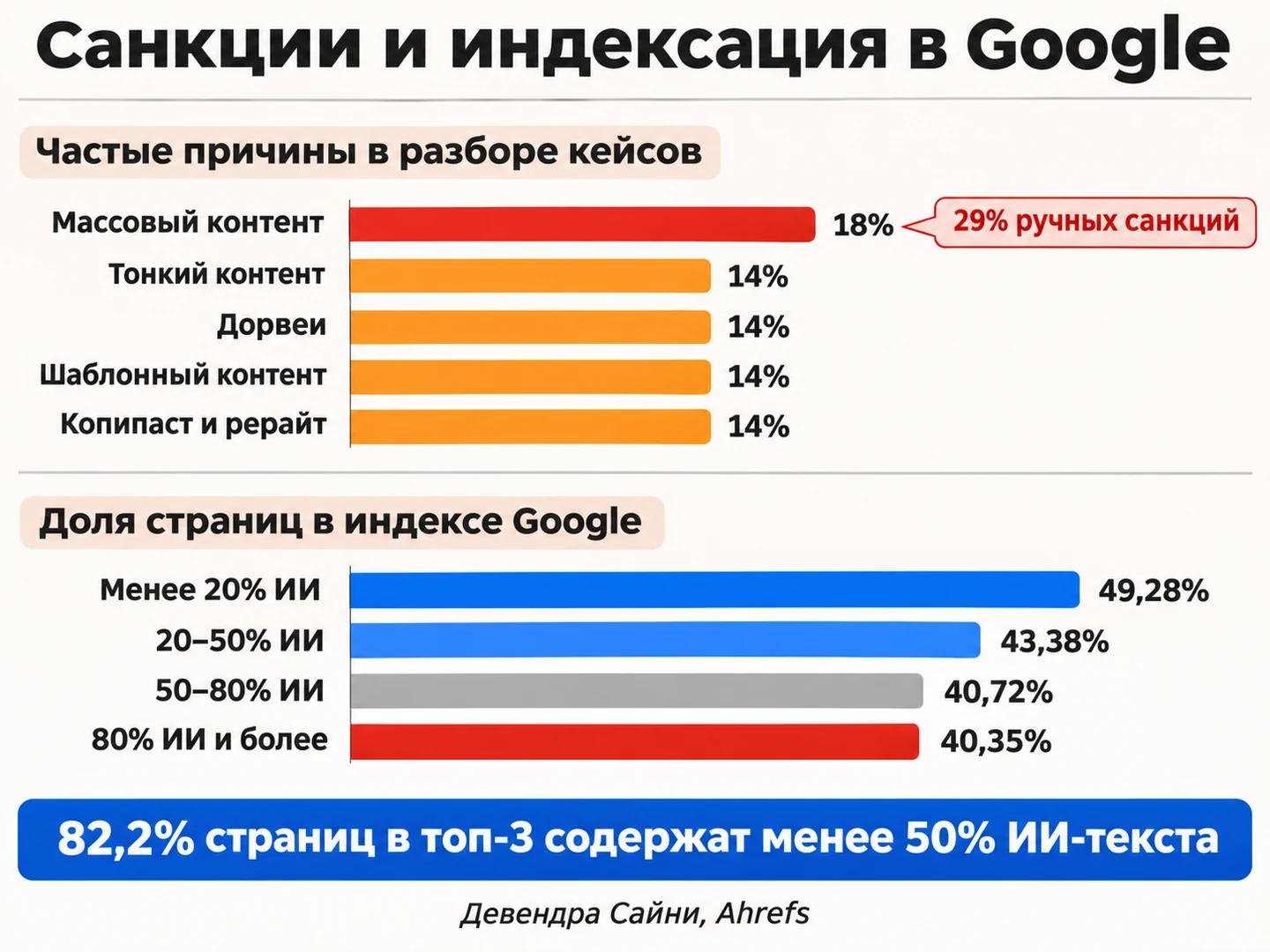
Neither Google nor Yandex can ban text only for the fact that the author used a neural network. By measurement Ahrefs (July 2026 years, 150 000 TOP - pages10 and100 000 Domains), fully generated texts take up 5.3% top 3, and 40,35% pages with an AI share above 80% still fall into the index. But the devil is in the details: 82.2% of pages in the top 3 contain less than half of AI text (54.7% of them are less than 20%), the gap in indexation is almost 9 p. m. (49.28% vs. 40.35%), and Human and hybrid texts receive 2-3 times more impressions.
They are punished for mass stamping without added use (Google policy) Scaled Content Abuse and host filter of Yandex IPC - "Little-Used Content", plus the quiet exclusion of low-value and low-demand pages - MMS How it kills a new domain, showed 16-month experiment Search Engine Land (March 2026): on 20 brand new domains posted 2 000 raw AI articles (according to 100 on the site). In the 1, the deceptive "honeymoon" occurred in the month (70,95% of pages in the index, 28% in the TOP-100), but Already in the 3rd month, positions fell to 3% in the TOP-100, In all 16 months 20 sites have collected a total of pitiful 1,381 Clicks (In medicine and finance, only 9-14 pages out of 100 survived in the index)
In Dissect 420 complicated cases the Google Search Central forum (Devendra Saini, 2026) Reason No. 1 of sanctions (18 percent of diagnoses) 29% of manual measures after c. 14% There was thin content, template city roads and rewriting. In 18 of 48 cases, the manual measure cut out a whole section (most often /blog The removal required an average 4-5 applications for review.
3. Exchange SEO links, cheap grids (PBN) and spam with accurate keys
Google Neural Network SpamBrain Automatically neutralizes from above 99% link spam: Buying cheap links from exchanges and primitive networks of sites (PBN) in most cases turns into a quiet drain of money. But if you go over with accurate commercial anchors (above 15%) or get to hacked sites, a direct fine will come. In Yandex, the massive buying of non-thematic exchange links still ends with a host filter "Minusinsk", Releasing the site for 6-12 months.
4. Buying a “drop domain” without deep verification and 301-redirect with a fine
The old advice of "buy a free domain with age to bypass the sandbox" in 2026 became a minefield:
* Google has been in spam policy since March 2024 Expired Domain Abuse (abuse of expired domains), and on March 28, 2025, Yandex directly included the purchase of domains of closed firms under weak content in the list of punishable schemes.
* Google’s manual sanction can survive the change of ownership, non-thematic old links cause suspicion instead of benefit, and even a “clean” parked drop takes months to reset its previous status (confirmed by John Mueller in September 2025). In the domain industry became a textbook case of deindexing the domain anxiety.org, purchased for $100,000!
* The most dangerous mistake: set up 301-redit from the old penalized site to a new clean domain - John Mueller himself confirmed on a real case that algorithmic reference sanctions go through the 301-redirect and stick to a new domain even after the redirect is disabled. Drop is justified only with 100% match niche and deep verification of the archive and links; for white business, the pure brand “Novoreg” is much safer for years to come.
5. The second clone site (Yandex affiliate filter), fictional authors and manipulations under AI
Trying to take two places in the issue of Yandex using a “duplicate site” on the same phones, TIN, address or catalog includes Affiliate Filter: in the top 10 there is one site, and the second one is quietly displaced to 20-30th place without notifications in the Webmaster. To the new risks of 2026, fake “expert authors” were added to simulate E-E-A-T, cheating reviews and trying to deceive AI systems with hidden text or fake mentions (Google has been explicitly banned since May 15, 2026).
| Advice or Gray Method | Risk category | The real effect in 2026 | Implications for the new domain |
|---|---|---|---|
File llms.txt as a paid service | Myth (wasting money) | 97% of files are not readable by bots; effect in AI -0,1 pp | No harm, but it drains budget and time |
| Mass FAQ-marking / fake dates | Outdated / Myth | Google Disables FAQ Blocks May 7, 2026; Fake Dates Recognized | Loss of time and loss of confidence in freshness |
| PF cheat in Yandex (bots / exchanges) | Critical risk | Short takeoff for 1-3 months. or cut off antifraud (>95% detection) | Hosted Whole Domain Ban (~8+ months) |
| Mass Raw AI Texts / Geo-Dorves | Critical risk | 1-2 months. "honeymoon", then a drop to 3% in the TOP-100 | Scaled Content Abuse (Google) / host IPC (Yandex) |
| Exchange links and spam with anchors | High risk | >99% spam-link resets SpamBrain; in Yandex - "Minusinsk" | Budget drain or drawdown of the site for 6-12 months. |
| Unverified drop / 301 from filter | High risk | Speeds up the start only if the niche and story are perfectly clean | Expired Domain Abuse, inherited ban, long reset |
| Second clone site for the same details | Average risk | Trying to take two places in the search results of Yandex | Affiliate filter: departure of the second site in the TOP 20-30 |
Solution traffic light: treat a penalized domain or start over?
If a young site has already managed to step on the rake (for example, a previous contractor turned PF or poured 500 AI articles), make a pragmatic decision:
* Red light (cheap restart on a new domain): site less than 6-9 months, there is no large brand demand and hundreds of natural links, and the host ban arrived for cheating PF in Yandex8+ months) or severe sanctions at Google (exit from heavy content sanctions, as in the famous case HouseFresh After losing 95% of visibility, it takes 1-2 years). Hard restart condition: complete rejection of spam schemes, deep processing of pages and No 301 redirect from an old compromised domain!
* Green light (treat current domain): Behind the domain is already a recognizable brand, live direct visits, accumulated reviews on Maps and real customers - in this case, clean problematic pages / links, close the cause of the filter and submit for revision.

6. How much time do you really need before stable applications: “valley plateau”, the price of domain change and live cases (2023-2026)
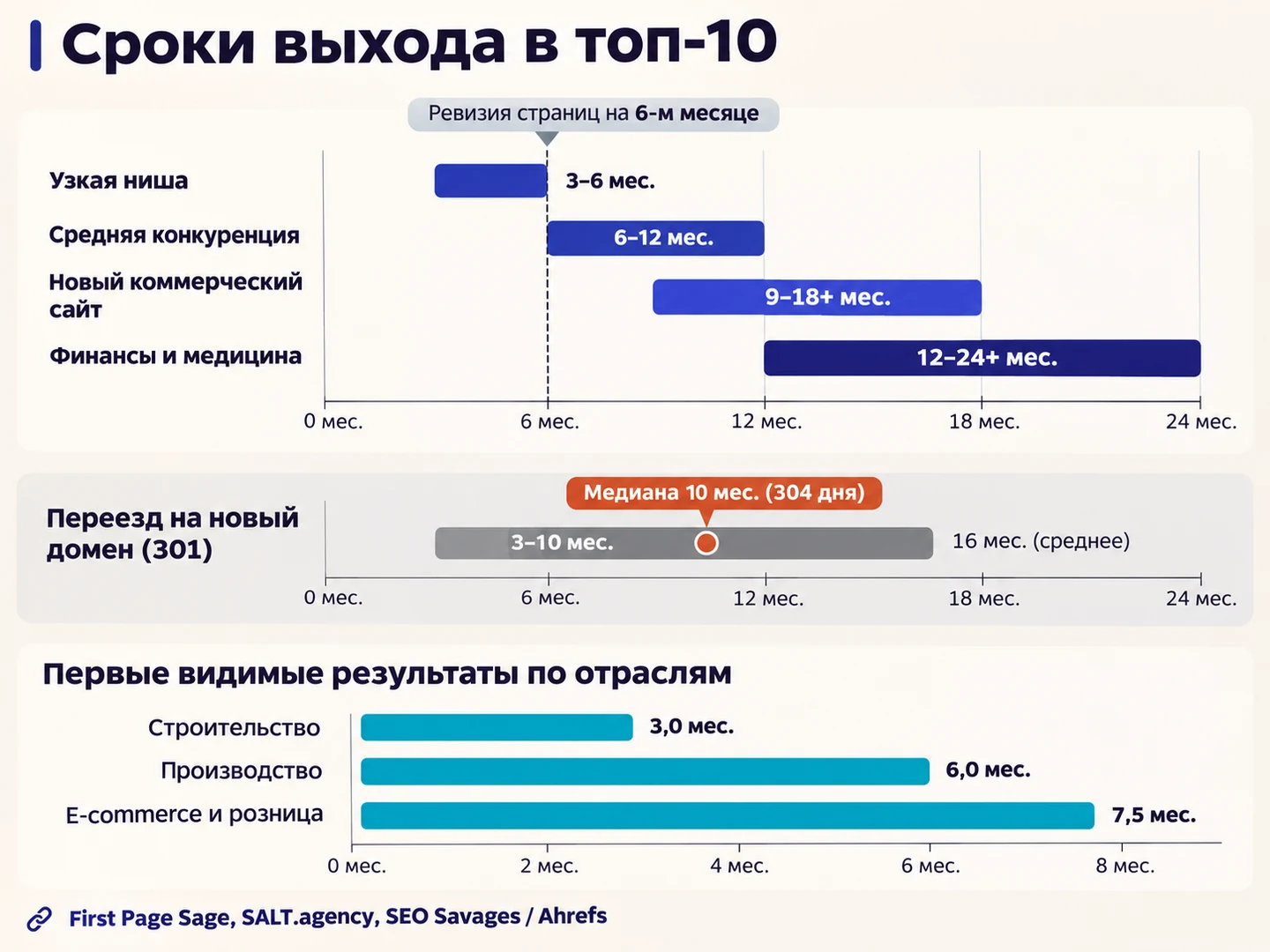
Google’s official reference calls the honest horizon a noticeable return on SEO – 4-12 months. In practice, in 2026, the timing depends on the gap of authority between your new site and the current top 10:
* Narrow or local niche: The first movement for 1-3 months, stable top 10 and applications for 3-6 months.
* Average competition (millionaire/country): the First Shift 3-6 months, A steady stream of applications for 6-12 months (for a fresh commercial domain from scratch - often 9-18 months).
* High competition and sensitive YMYL niches (finance, medicine, law - topics that affect people's health and money): the first shifts in 6-12 months, A sure way out to the top - 12-24+ months.
* Average lead time to first visible results by industry (First Page Sage, base on all industry sites, for the zero domain, put an adjustment for the starting gap): construction - 3.0 months, Production and distribution - 6.0 months, The security systems – 6.0 months, Legal services and medical equipment - 6,5 months, and finance – 7.0 months, online stores and retail - 7.5 months.
Dangerous “valley plateau” on the 5-8th month and the trap of domain change
The growth of a young site almost never goes straight – it moves along S-curve. In a documented two-year case Sentosa Ltd (October 2024 - September 2026) on a fresh domain with almost zero ratingDR 3 The reference authority has grown to DR 36 The first 4 months, but then For seven months (from the 4th to the 11th), traffic stood on a flat plateau of 340-690 visits per month! And only in the 13th month there was a sharp breakthrough of more than 1,000 visits, and on the 15th - already 2 600 visits/month. It is on the 5-8th month of the “valley plateau” that dozens of companies are desperate to close SEO just two steps before payback.
The second iron rule of starting Choose a brand name once and for years to come. The largest study SALT. agency (26 June 2026, analysis) 1,052 domain moves with 301-redirects) showed a frightening price of changing address after launch:
* the median period of recovery of previous traffic - 304 Day (10 months), The average – 489 days (16 months);
* Only recovered in 90 days. 22,8% sites (in the title of the study - 27%), for the year - 59,5%;
* 13.9% of companies did not return the previous traffic even after three years! (Similar measurement 10 Spurs On 892 migrations, the average was 523 days and 17% of those that did not recover after 1,000 days.)
Successful cases and loud failures of young sites (Russia and the world, 2023-2026)
| Project and market | Starting point | What we did | Measurable result and time frame | The main lesson (and reservation) |
|---|---|---|---|---|
| B2B Engineering Networks (Spb and LO, vc.ru) | New site (September 2023), 0 leads, 5 keys top 10 Yandex, 0 Google; average order value from 500 thousand RUB | 25 landing + calculators, starting Direct from 1 month, manual exchange of publications (outreach), refinement of convenience (UX), further work for AI | 4 months: ~500 The visits, 3-5 Leads/month 15 months: Exit from the sandbox Google, 10+ leads. 36 months (Aug. 2026): 483 queries top 10 Yandex, 78 Google, 30+ B2B-leads/month, conversion 2% -> 11%, lead 1 529 ₽ against 2 900 RUB in Direct | Synergy with Direct and continuity overtake 15-year-old competitors. Reservation: Agency case. |
| “Clean Sky” (electronics online store, Russia, vc.ru) | new domain without weight, SEO is laid BEFORE launch; change the model to retail for 4th month; 0 RUB for advertising | Clean technical base, “smart filter”, Yandex Products, Yandex Maps + 2GIS, Zen, articles for AI, external mentions | 3 months (July 2025): 1,158 visits, 22 applications, 362,800 RUB. 15 months (July 2026): 13,784 visits~12x), 563 applications (~25,5x 46 orders, RUB 4.0 million / month (~11x), conversion 1,9% -> 4,1% | SEO before launch + ecosystem (Maps, 2GIS, Zen) accelerate growth without advertising. Disclaimer: The SEO budget is not disclosed. |
| Smart Climate Solutions (Climate Engineering, USA) | Fresh domain on Webflow, 16 clicks/month (Aug. 2025) | Technical SEO in development, parallel advertising, 213 narrow local articles (repairs, exact prices) | For 10-12 months (summer 2026): from 16 to 5,044 Clicks/Month (315x), 4,040 queries (513 on Google’s 1st page), core traffic yield 47 articles | Narrow selling parsing ("cost of repair/installation X") gives applications faster than common articles. Reservation: Agency case. |
| story. cv (SE Ranking) and deutschwunder. com (Reddit) | Fresh domains of May-July 2025 without history and droops | story.cv: focus on 1 narrow cluster (KD complexity 13). deutschwunder: Clean Fast Next. js | story.cv: 75 keys in top 10 (34 in one narrow cluster). deutschwunder: at200 visits/month from Google ~30% of traffic has already come from ChatGPT | The narrow cluster breaks the TOP early, and ChatGPT can quote a beginner before Google. |
| ANTIQUES: 20 fresh AI domains (Search Engine Land, 2026) | 20 new domains in 20 niches, 2,000 raw AI articles without editing and links | Mass filling, sending a site map, without further work | Mes. 1: 70.95% in the index, 28% in the TOP-100. Mes. 3: the Collapse 3% in TOP-100. For 16 months - only 1,381 clicks in total; 9/100 pages remain in the finances. | Raw AI content on a new domain is collapsing immediately after the “honeymoon”. |
| ANTIQUES: Telstar Consulting (USA, Sep. 2026) | New WordPress site (18 pages, June 2026) | In the first 10 days, the plug worked. crawl-delay, 429 CDN and 3 hour noindex | 90 days 8 main pages hung outside the Google index (Bing indexed in days); saved only by changing URL + 301 | Technically, a “dirty” release freezes Google’s indexing for a whole quarter. |
| ANTIQUES: Nike Store (Russia) and HubSpot Blog (world) | Online store in Russia; the largest B2B blog in the world (10-14.8 million visits/month) | Shop: basket for registration, no Yandex Business. HubSpot: thousands of articles outside its direct examination | Shop: Google vs Top 5 at 32nd place. HubSpot: 81% of blog organic traffic 2024-2025 (rewarded that 83% of traffic is direct visits) | Commercial blunders kill Yandex; “write about everything” is punished by updates to the Google kernel. |
(Note: in the fall of 2026, microcases like exoskill.ru with 412 visits for 228 narrow phrases in 1-3 months without references or solaris-club.one With 311 visits from search, it is useful to take them as confirmation of a rapid indexation of narrow demand, but not as a benchmark for competitive commerce.)

7. How much money is really needed at the start in 2026 (and two hidden articles, which are silent in the price list)
Underfunding SEO in the first 6 months and not taking into account hidden costs is the second main reason for disappointment immediately after inflated expectations on terms. According to the survey Topvisor (150 SEO specialists of the Russian Federation), 54,1% Increased customer budgets, 64,3% freelancers raised rates, and the main problem of working with business was called precisely the expectation of quick return. In the world review SE Ranking and Duda (260 agencies) prices raised or up 70% of companies.
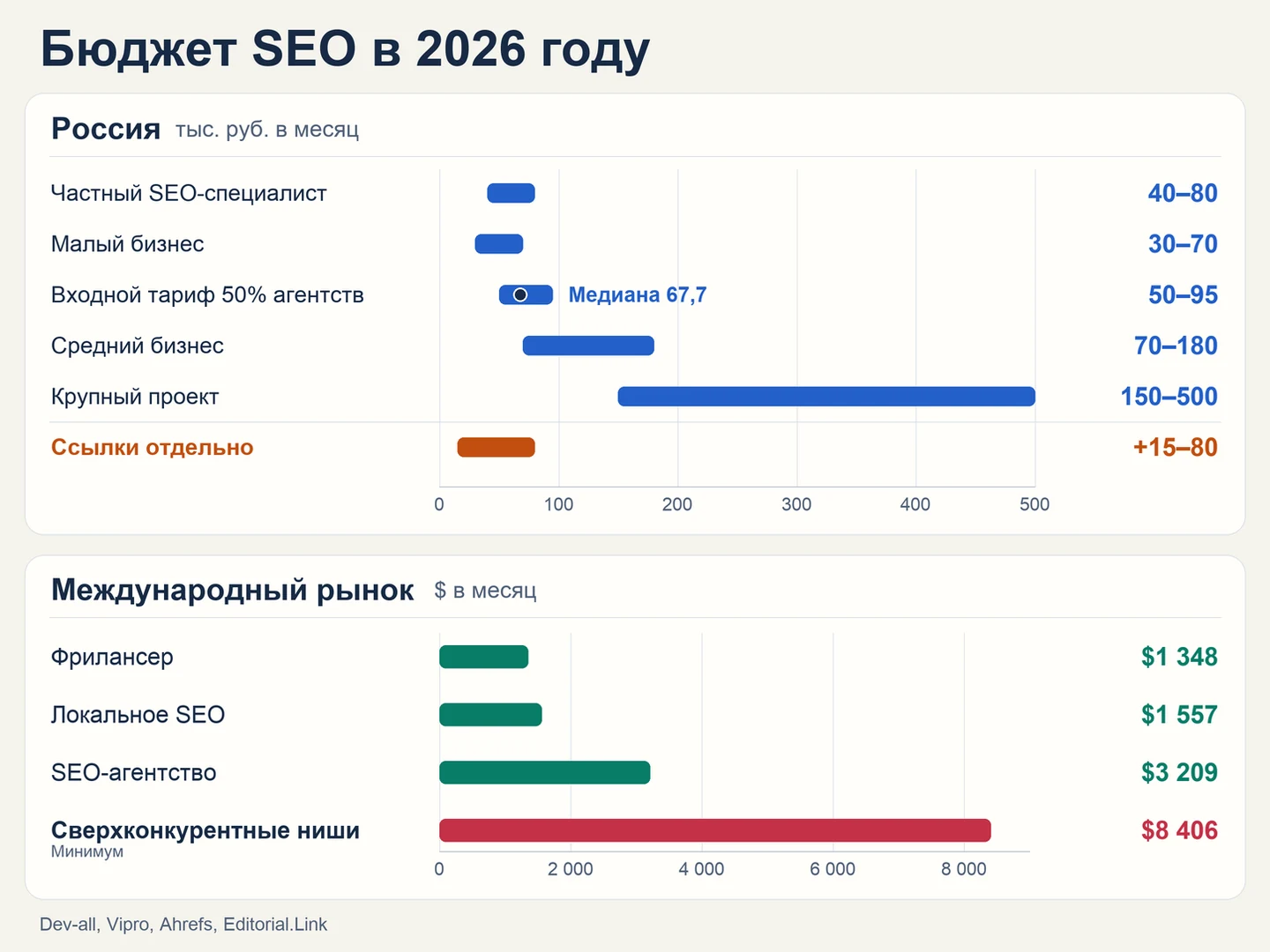
Fresh cut of open tariffs 22 well-known Russian agencies the October 2026Dev-all) and global surveys Ahrefs (439 contractors) and Editorial. Link (518 specialists) show the real fork of the market:
* Private SEO specialist in Russia: 40 000 - 80 000 RUB /month
* Small regional business (services): 30 000 - 70 000 RUB /month
* Admission fee 50% of Russian agencies: 50 000 - 95 000 RUB / monthmedian - 67 700 RUB / month, average - 78 000 RUB, in the top 10 agencies - from 95 000 RUB ).
* Medium business and online stores: 70 000 - 180 000 RUB /month
* Large or highly competitive project: 150 000 - 500 000 RUB /month
* For comparison in the international market: Average rate - $111/hour, Freelancer - $1,348/month, Local SEO – $1,557/month, The average agency – $3,209/month, and the minimum entry into super-competitive niches - $8,406/month.
But the entry tariff itself in the contract is only the tip of the iceberg. In practice, the budget almost always turns out to be 1.5-3 times higher than the starting line of the price Because of two hidden articles:
- Real economy hours within the agency: by parsing Dev-all, In the agency, the work of the SEO specialist himself goes about 55% of the subscription fee (the rest - managers, sales, software, taxes and margins), and one optimizer often leads to 15 projects, giving each 10-11 hours per month. As a result, the tariff 60 000 RUB / month actual hour of the key specialist costs about 5 600 ₽, at 80 000 RUB - in 7 500 ₽, At 110,000 RUB, it is already 10 300 ₽ (against the rate of 1000 - 2 500 RUB / h directly from a strong private specialist).
- Costs that are usually beyond the basic tariff:
* Budget for External Links and PR Publications+15 000 - 80 000 RUB /month in the Russian Federation; on the global market, the average price of one quality link - $509, PR-publications - 500-2,000+ dollars);
* the Clock of the Programmer for Site Improvement2 500 - 5 000 RUB / h in the Russian Federation);
* profile expert copywriting and proofreading;
* VAT, subscriptions to professional analytics services (for example, Ahrefs Lite - 129 dollars / month, Standard - 249 dollars / month), Yandex Direct (8-20% of the budget or 30-80 thousand RUB / month) and individual surcharges for packages for AI systems (up to +50,000 RUB / month from large agencies).
Fair cash reserve for the first 6 and 12 months (Russia, 2026 guidelines, without a budget for advertising clicks)
| Launch format in Russia | Real monthly costs (with content and edits) | Cash reserve for the first 6 months | Cash reserve for the first year | Time of owner |
|---|---|---|---|---|
| 1. Independently + point performers | 5-25 thousand RUB / month (services, texts, one-time edits) | 30-150 thousand RUB | 60-300 thousand RUB | 10+ h/week (~260+ hours in six months) |
| 2. Regional small business (private / small agency) | 45-95 thousand RUB / month (30-70 thousand SEO + 15-25 thousand content, directories, edits) | 270-570 thousand RUB | 540 thousand - 1.14 million RUB | 2-4 h/week for examination and approval |
| 3. Competitive niche / online store (medium-sized agency) | 100-260 thousand RUB / month (70-180 thousand SEO + 30-80 thousand links, development, content) | 600 thousand - 1.56 million RUB | 1.2 - 3.12 million RUB | 3-5 h/week + Developer resource |
Break-even point of young SEO on fingers (simple check before start):
Let’s say you invested in the first year of promoting regional business 720 000 ₽ (60 000 RUB / month, taking into account content and edits), and the net margin of your company from one order is 40 000 ₽. To fully beat the annual SEO budget, the site needs to bring everything 18 paid transactions - that is, on average 2-3 orders per month after entering the working mode in the second half of the year! And in the second year, each new application from already displayed in the top pages ceases to require pay per click and works for your profit.
Why are these investments paying off on the horizon of 1-2 years? Due to the continuous rise in the cost of paid advertising. In the United States, the average click in Google Ads for 10 years has more than doubled - from 2.32 to $5.42, Google’s own model estimates organic clicks at 70% of the value of paid with almost equal conversions.4,9% Organics Against 5,4% in advertising for 110 million sessions Ruler Analytics, May 2026). In Russia contextual advertising for 2025-2026 has risen in price even more on 25-30%, and in the B2B case of engineering networks from Chapter 6 to the third year, the organic lead was worth 1 529 RUB vs 2 900 RUB in Direct (on 47.3% cheaper), continuing to bring customers from already ready pages without paying for every click.
Digit validity filter (honestly separate facts from estimates): official documentation of Google and Yandex (ePOS criteria, opt-out)
llms.txt, disabling FAQ-snippets May 7, 2026, prohibition of cheating PF and drapes), measured Pew Research (8% vs 15%), study SALT. agency (median move 304 days), Ahrefs (llms.txt97%, 37.9% AIO from top 10) and "Ashmanov & Partners" (Running Alice from 40% to 10% outside the top 10) - this is empirical facts. Yandex code leaks (2023) and Google API (2024) confirm the existence of mechanisms (hostAge,NavBoost, Behavioral, but They do not reveal their exact weights. I. Survey Whitespark 2026 - Consensus 47 experts. Correlation of references Ahrefs (0,737on YouTube) Statistical relationship, not proven cause. And the table of cash stock above - Market benchmark, It is important to check with your margin.
8. How to control growth by months, a 12-month launch plan and 7 questions for the contractor
The main control error on the new site is to evaluate the contractor’s performance in the first 3-4 months by the number of sales from free search. Applications and revenue are lagging indicators: they lag behind clicks by 1-3 months (plus the length of your transaction cycle), and clicks lag behind the first impressions for another 1-2 months. In 2026, we need to look at Forward Signals and separately count three layers of AI search: brand mentions -> direct transitions from AI -> real applications (not mixing them into an artificial “single GEO-ball”).
An important warning for reading Google Search Console charts: If you compare your new site with old projects, remember two anomalies Google - confirmed failure of the count of impressions from May 13, 2025 to April 27, 2026 (clicks were not affected, but impressions and positions were distorted) and disabling the technical ability to request 100 items at once (option num=100 In September 2025), after which 87.7% of the sites tested sharply dropped desktop impressions. The site, launched in the second half of 2026, has clean graphics, and in November 2026 Google added a separate filter for branded queries.Branded Queries) allowing to honestly separate non-brand growth.
Table of monitoring the progress of a young site (Months 1-12)
| Stage | Leading indicators of the norm | Where to check | Alarming red flags (urgent audit required) |
|---|---|---|---|
| Months 1-2 (Indexation and base) | In the index from 85-90% main commercial pages; 0 server errors 5xx and Mass 404; OAI-SearchBot and PerplexityBot Get 200 OK; confirmed by Yandex Maps, 2GIS, Google Maps; went the first reviews and applications from maps/Direct | Yandex Webmaster, Google Search Console (GSC: Indexing and Crawl Stats), Bing Webmaster Tools, Metrics | The main pages are in Discovered - not indexed longer than 4 weeks without visits from the main Googlebot; mass status of MMS in Yandex |
| Months 3-4 (First Appearance) | Stable growth of non-brand impressions; the number of unique requests in panels doubled; narrow phrases enter the TOP-20-30; first test slips in Yandex; first mentions in Perplexity (by manual check 30-50 questions) | GSC, Yandex Webmaster (Search Monitoring, Visibility in Alice AI), Prompt Checklist | Zero impressions or a sharp collapse after 1 month (symptom of raw AI texts); failures above 40-50% the Test Events |
| Months 5-6 (Inflection point and audit) | The first narrow and local commercial pages are in the top 10; clicks catch up with impressions; demand for the brand name is growing; Yandex site quality index (YKS) has moved from zero (10-50+); the first regular applications from search and maps | Yandex Metrica (targets and call accounting system), GSC (non-branded slice), Webmaster | Frontier of the 6th month (Ahrefs data): pages that are not included in the top 10 for six months, rarely "mature" themselves - they need to be processed according to the client's request! |
| Months 7-12 (Scale) | Growth of medium-frequency commercial phrases; stable flow of applications; falling average price of leads (SEO + advertising); quarterly update of the best pages; growth of citations in Alice AI / Google / ChatGPT; 5-15 new thematic donors per month | End-to-end analytics / CRM, Yandex Webmaster (Alice report is updated once a week), Ahrefs / Topvisor | Traffic grows only due to non-targeted articles in the blog without applications; on informational queries, impressions grow and clicks fall (it's time to change the feed to the format of the AI source) |
From the practice of RM Systems: The most common reason for the break in the contract between an entrepreneur and an SEO specialist at the 4th month is that the owner does not see the money, and the contractor sends a “sheet” of incomprehensible technical words. On RM Systems projects, we have been keeping a simple management report for the young site from the first month: the percentage of key page indexing, the dynamics of non-brand impressions and clicks, real applications for each landing page in CRM and monthly manual check of 30 main customer questions in Alice AI, ChatGPT and Perplexity - this is how the owner sees the real movement at the stage of the “plato valley”.
Step-by-step plan for launching a young site for 12 months (5 stages with 1-minute owner check)
Stage 1 (Weeks 0-2): Clean Release and Connect All Three Panels
What the owner personally checks (1 minute): open the site from a regular smartphone on mobile Internet (not office Wi-Fi), track the time of the price and order button, and ask the developer to show screenshots of the response code
200 OKwithout tagsnoindexandcrawl-delay.
* Remove all stubs, CDN limits, broken links and check pure HTML in source code (SSR).
* Connect Yandex Webmaster (include "Metrics Meter bypass" and IndexNow Google Search Console and Bing Webmaster Tools; make sure that OAI-SearchBot and PerplexityBot not blocked.
Phase 2 (Month 1): Commercial Foundation, Three Geoservices and Point Advertising
What the owner personally checks (1 minute): try to place an order or order on your own website as an unfamiliar client - is the clear price, company details, warranty conditions visible and does the form force you to register?
* Close all Yandex commercial factors (transparent prices/forks, TIN/OGRN, delivery, payment, warranty, online chat).
* Fill and synchronize to comma card in Yandex Maps, 2GIS and Google Maps (this gives 1.5 times more traffic), set up a regular collection of real reviews with responses to each.
* Include a narrow Yandex Direct / Google Ads on hot commercial queries - in 3-4 weeks get the first sales and check what formulations and pages actually convert.
Stage 3 (Months 2-3): Narrow cluster attack "Hub + spokes"
What the owner personally checks (1 minute): read the first screen of any new page - is it clear in 10 seconds what exactly you are selling, who it suits and how much it costs (the rule of clarity of the offer)
+11,2 pp)?
* Focus on the 1-2 most profitable narrow clusters: a separate strong page for each service / subcategory + 5-10 selling parsing of the bottom funnel (estimation, comparison, cases, answers to fears).
* Write on the principle of "First direct response" (conclusion and numbers in the first 40-60 words), put real authors (EPOS standards and E-E-A-T) and basic net micromarkup (Organization, LocalBusiness, BreadcrumbList, Plus it is necessary Product goods) without spending money on llms.txt.
Step 4 (Months 3-6): “Loan Trust” on external sites and secure links
What the owner personally checks (1 minute): inject 5 typical questions of your client into "Alice AI" and ChatGPT - write out 3-5 third-party ratings and sites from their answers and check whether there is a mention of your company with current prices and facts.
* Release 2-4 strong expert materials with real numbers and cases on authoritative sites (VC.ru, Habr, Zen, YouTube) - this brings citations in AI systems and live clients at times faster than the new domain.
* Start the smooth growth of quality thematic links (3-10 profile sites per month, 70-85% branded and unanchored) and keep a steady rhythm of 1-2 quality updates or publications per week.
Phase 5 (Month 6 - Audit, Months 7-12 - Scaling)
What the owner personally checks (1 minute): exactly on the 6th month, request a list of pages at positions 11-20 (stepping away from the first page) and a list of pages with zero impressions - it is their processing that gives the fastest breakthrough in the second half of the year.
* Conduct a mandatory audit of the 6th month: combine weak takes, strengthen the texture and linking of the page from the second page of issue, update the best materials with fresh data (do this once a quarter).
* Release 1-2's own industry mini-research, calculator or price review - such pages attract natural links and AI quotes in 3,2 times more active than regular articles.
7 control questions to the contractor before starting SEO for a young site (copy before signing the contract)
Send this list in correspondence to an agency or a private specialist - in five minutes you will weed out the sellers of "magic pills" and gray schemes:
- “When will we see the first shifts and when is a steady stream of applications for a new domain in our niche?”
Healthy answer:* indexing 1-4 weeks, first movements on narrow requests for 2-4 months, stable commercial applications for 6-12+ months (taking into account the “plateau valley” and revision for the 6th month).
Red Flag:* “We guarantee top 3 and payback throughout the niche in 60 days.”
- “Do you use behavioral cheats (PF) or buy cheap links from exchanges to speed up the start?”
Healthy answer:* No, on the new domain, the cheat gives Yandex host ban for 8+ months; we accelerate through a clean technical base, narrow clusters, Yandex Maps/2GIS, point Direct and publications on external trust sites.
Red Flag:* “Without a soft cheat PF today in Yandex do nothing – we have proven bots, no one will notice.”
- “Should we buy an old drop domain instead of launching on a new brand name?”
Healthy answer:* for white long-term business, pure “Novoreg” is safer; drop is allowed only with 100% coincidence of the subject and a deep audit of the history, otherwise there is a risk to inherit the filter or get under Expired Domain Abuse.
Red Flag:* Of course, take any drop with age - plywood 301-redirect and immediately go around the sandbox! "
- «What will be included in our work on AI systems (Alice AI, Google AI Reviews, ChatGPT)? Do I need to pay extra for
llms.txt?»
Healthy answer:* file llms.txt not sold separately (it is almost not read by bots); we bet on getting into the top 10 of Yandex (for Alice), clear answers at the beginning of pages, coincidence of facts about the brand throughout the network, markup Product (if the store), Bing Webmaster Tools connection and output to the quoted ratings/media/VC.ru.
Red Flag:* “Add a paid GEO package for +50,000 RUB: hall llms.txt, We’ll hang up the FAQ and bring you out No. 1 in ChatGPT.”
- “How many hours of real time are included in the tariff and what expenses are not included in the estimate?”
Healthy answer:* transparent layout of the clock + an honest list of pre-departures before the start (budget for links / PR, programmer's clock, expert copywriting, advertising).
Red Flag:* “We have everything included for 45 000 RUB / month” (after signing, it turns out that texts, programmers and external sites are paid separately).
- How do you protect your website from indexing errors in the first week after launch?
Healthy answer:* closed-end test, clean answer checklist 200 OK without caps/noindex/crawl-delay, setting the Metrick counter bypass, IndexNow, GSC, Bing and access verification for OAI-SearchBot and PerplexityBot.
Red Flag:* “Drop it out as you go, then finish the pages in progress.”
- “What indicators will we measure progress in the first 6 months?”
Healthy answer:* Leading indicators (KPI) by months (percentage of indexation, growth of non-brand impressions and clicks, retention on the page, applications in CRM with reference to landing pages and cards, manual verification of 30 prompts in AI) + mandatory revision on the 6th month.
Red Flag:* “We report a plaque of 150 items” without data on applications and indexing.
The main conclusion: three steps for the next week
Promoting a new website in 2026 is not a lottery or a war of budgets with 15-year-old giants. The winner is not the one who bought more bots or flooded 500 AI articles faster, but the one who from the first day made a clean and fast site, honestly answered commercial questions of the buyer, connected external trust platforms and calmly survived the “valley of plateaus” to the point of takeoff.
This week, three simple steps are enough:
- Fix the clean technical and commercial foundation: check that the site has no stubs and hidden indexing bans, connect Yandex Webmaster (with a bypass of Metrics and
IndexNowGoogle Search Console and Bing Webmaster Tools, and on the first screens show clear prices, details and working conditions. - Choose one narrow profitable cluster instead of fighting for the whole market at once: get a strong page for each specific service, fill in the cards on all three geoservices (Yandex Maps, 2GIS, Google Maps) and turn on the point Direct for first payments and demand intelligence.
- Set an honest financial horizon for at least 6-12 months (taking into account content, edits and external sites) and in the first quarter will release 2-3 strong expert analysis with figures on the sites that quote Alice AI and AI systems right now.
Launching fast sites with a ready SEO foundation: RM Systems Multipage Sites, Landings and Online Stores on Astro with clean HTML, indexing settings for Yandex, Google and AI search, and also connects Telegram and MAX bots and Integration with CRM From the first month of work.
Author: Roman Mikhailov, RM Systems.