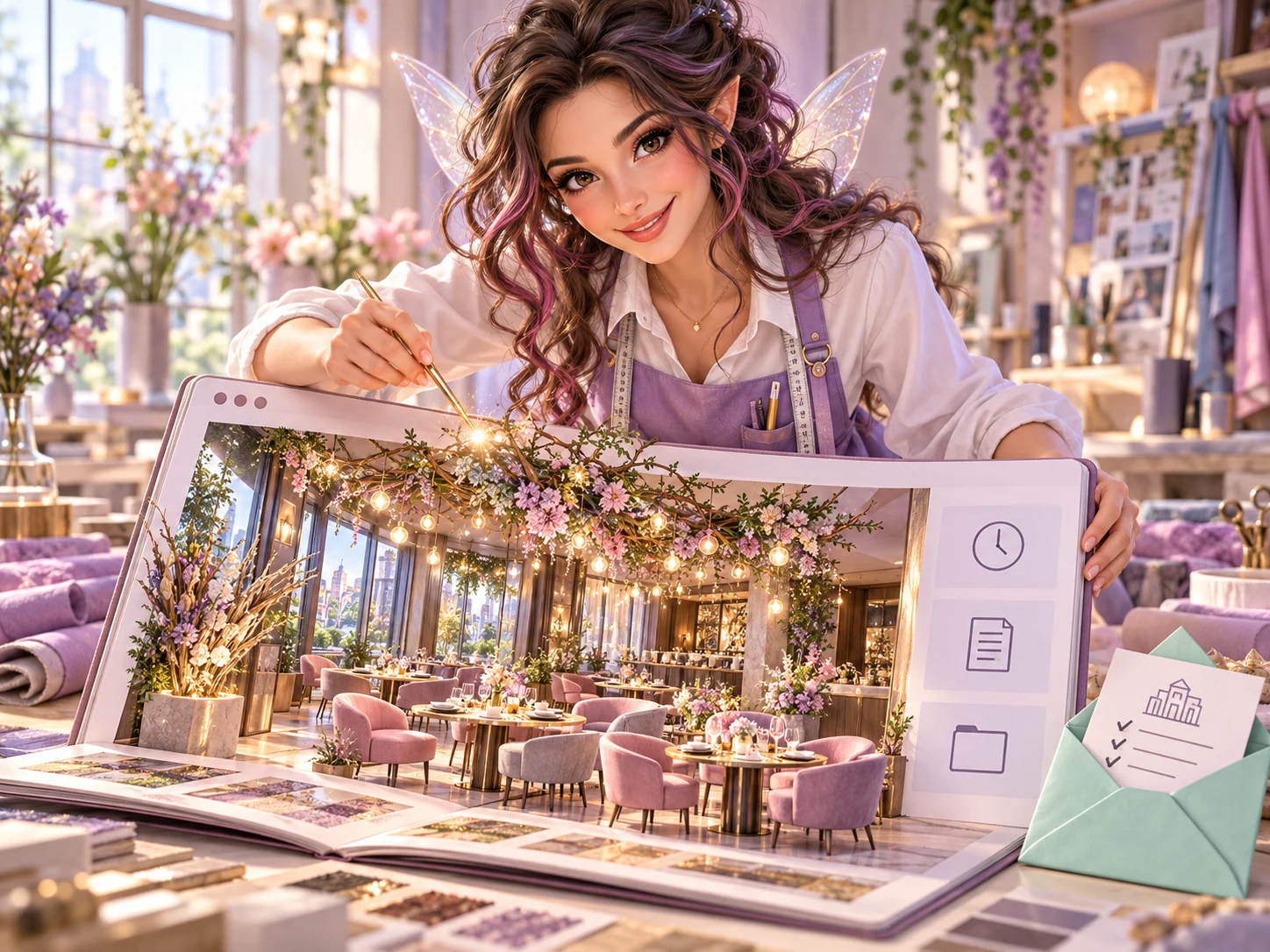
You completed a project you are proud of. A restaurant became a winter forest for New Year: garlands in branches above the tables, lights at the entrance and a photo area with guests queueing to use it. A photographer captured everything beautifully, and you published 40 images. Likes, hearts, “wow”. A month later, you have no more orders than before.
Sound familiar? The photographs are not the problem. A photograph creates the first “I want that”. The order goes to whoever answers the questions that follow.
Visual businesses often have the same problem: a wonderful gallery without answers to a customer's questions. Let us look at how to fix that for a studio decorating commercial spaces: restaurants, offices and shopping centres.
The trust ladder: six steps from photograph to enquiry
A restaurant manager, office manager or shopping-centre marketer is not buying “beauty”. They need to report to the owner and meet a deadline. After that initial “I want that”, the customer has six steps to climb:
- “This is our style.” Photographs do that work.
- “They decorate this kind of venue.” Restaurants, rather than only weddings.
- “They have handled something similar.” A room our size, with a similar task.
- “It fits our budget.” At least an approximate price.
- “We can trust them.” Reviews, clients and a real business.
- “I know what to do next.” What to send to get an estimate.
A gallery covers only the first step. The customer has to find out everything else independently, or go to a studio that has already explained it.
Channels: each covers a different step
No single channel covers the whole ladder, so depending entirely on one social network is risky. Give each channel a role:
- Portfolio website. The main asset: it brings all six steps together and remains yours regardless of what happens to platforms.
- Yandex Maps. Free, and answers four checks: is this a real business, does it work in our city, what do customers say and where can I learn more? According to Yandex, more than 85 million people a month search for goods and services in Maps.
- Partners. Often the warmest enquiries, discussed below.
- Avito. A shop window for specific products: “Restaurant decoration for New Year”, “Decor hire and installation”. It needs scope, starting prices and timings rather than 80 inspirational photographs.
- VK and Telegram. Evidence that the business is active: recent projects, installation work, team members and reviews.
- Pinterest. A lasting display of ideas: turn each strong case study into five to ten images linking to its page. But do not rely on it as the main source of Russian orders.
- Paid advertising. An accelerator. Switch it on last, once the website can turn visitors into enquiries.
Partners: people who meet your customer before you do
For commercial venue decoration, these relationships can be particularly valuable. Event agencies, venues, interior designers, restaurant and shopping-centre managers, and caterers hear about projects before you do.
Do not send “let us collaborate” to everyone. Choose 15-30 priority partners in your city and give each one page with three to five relevant case studies, price ranges and collaboration terms.
A partner can send “here is their VK page”. Or they can send a page showing a similar restaurant room, a starting price and a “Get an estimate” button. The second makes recommending you much easier.
A case study instead of a gallery
A beautiful photograph does not explain which work was yours, how the space looked before, what it cost, how long installation took or whether the client was happy. The website's main unit should therefore be a venue case study, rather than a photograph. A template:
“New Year decoration for Restaurant Name, [city]”
Immediately below the heading, show a short line of facts:
120-seat dining room · entrance, room and photo area · overnight installation · projects from RUB 180,000
Those figures are examples; use your own. Then explain, in order:
- Brief: what the client wanted to achieve and avoid.
- Original space and its constraints.
- Concept: why you chose these particular solutions.
- Before and after, photographed from the same position.
- Eight to fifteen photographs, rather than forty similar ones: scale, details and evening light.
- A short video: a walk through the room, switching on the lights or a time-lapse installation. Repeat essential information in text: a search engine will not get the explanation from a silent clip alone.
- Facts: venue, season, area, zones, installation time and budget, if the client allows disclosure.
- A review about that particular project.
- Next step: “Preparing your restaurant for New Year? Send photographs of the room and your dates.”
Before and after is stronger than after alone. “After” shows your taste; “before → after” shows your work. This is especially useful with unremarkable starting points: an ordinary restaurant room, grey office, empty terrace, lobby or entrance. The customer sees a transformation of a space resembling their own.
Name the venue. A manager familiar with a nearby shopping centre is more likely to open “New Year decoration at Shopping Centre Name”. Search engines get a unique page connecting a service, venue and city. According to its SEO agency, New York's Cloud Catering increased search enquiries from 52 to 73 in six months, helped in part by dedicated pages for venues where it worked.
Should you publish prices?
Yes, show a starting point rather than a complete price list:
- photo areas: from X RUB;
- entrance decoration: from Y RUB;
- full restaurant New Year decoration: from Z RUB;
- shopping centres: estimate after photographs or a visit, projects from N RUB.
A starting price does not promise an exact quote. It filters out a customer expecting RUB 20,000 when your projects start at RUB 120,000. You save hours of correspondence that would not have led to an order.
There is no need to invent “Silver, Gold, Platinum” packages. For bespoke decoration, a range and real projects are more honest.
Enquiries: one short form
“Leave an enquiry” promises little. Use a specific action:
“Get an initial decoration cost estimate”
Keep the form short: venue type → city → dates → approximate budget → phone or messenger, with an optional “Attach photographs of the space” field. Dimensions and details can be clarified after the first response. A 12-question quiz on the opening screen will discourage more people than it qualifies.
Do not forget the Russian legal requirements: since 1 September 2025, personal data consent needs a separate checkbox, along with a privacy policy and notification to Roskomnadzor. Yandex Metrica is the more straightforward analytics choice: the Ministry of Digital Development has explained that Google Analytics may be treated as a cross-border data transfer. More in “Website fines in Russia in 2026”.
How people will find you in search
A common decorator website structure is home → about → enormous gallery → phone number. Search engines simply have no pages answering different searches.
Someone searching for “New Year restaurant decoration Kazan” should reach a restaurant page with restaurant case studies. An HR manager looking for “office New Year decoration” should not have to scroll through weddings. A possible structure:
- New Year decoration, with separate pages for offices, restaurants and shopping centres;
- entrances and lobbies, photo areas, corporate events and openings;
- portfolio, with a separate page for each venue;
- prices, studio, reviews and contacts.
Ten to fifteen substantial pages are enough. You do not need a hundred pages with a different city name inserted into each. The approach is explained in “What is SEO?”.
For a visual site, photographs are critical. Name a file new-year-restaurant-decoration-city.jpg rather than IMG_7485.jpg. Write a human description: “Garlands in branches above the tables at Restaurant X”. Watch the file sizes too: in one wedding agency case study, heavy photographs slowed the site so much that they had to be cropped and compressed. Keep originals in your archive and publish lighter versions.
The season starts earlier than you think
Commercial New Year decoration involves lengthy approvals. Decor suppliers report that larger clients start planning in summer. If you start promotion in November, much of the opportunity has already gone.
- January to March: publish case studies from the recent New Year season while the photographs are fresh.
- April to June: summer terraces, openings and corporate events.
- July to August: prepare New Year pages and approach larger clients.
- September to October: the main push for restaurants, offices and shopping centres.
- November to December: installations; advertising only for remaining availability.
Can search bring orders without advertising?
Yes. But without adverts does not mean at no cost. You do not pay for clicks, but you pay with time or money for structure, case studies, copy, image processing and analytics.
An honest example: Chicago event company Firmly Rooted Events received no bookings from Google in 2024. After a website rebuild and SEO work, search bookings appeared in 2025, and total bookings rose from 33 to 61. The case study's author also notes that the business rebranded and expanded its team. The conclusion is therefore that search can become a working channel from nothing, rather than “SEO will double sales”.
For a new site, the following is guidance rather than a promise: the first weeks bring indexing, one to three months may bring service impressions and initial enquiries, three to six months show whether commercial enquiries arrive, and six to twelve months show whether search has become a channel of its own.
One telling detail: a Russian SEO agency advertises “results in 30 days” on a page whose case study describes work from 2019 to 2022. That is the gap between a promise and what the example actually demonstrates.
What it costs
The platform is inexpensive. Tilda Personal costs RUB 500 a month when paid annually, Business RUB 1,000, and Craftum starts at RUB 149. Paid Tilda plans can host a multi-page website on your own domain, rather than only a landing page.
Building prices vary widely. Freelance marketplaces offer “Tilda site from RUB 500” or a landing page for RUB 5,000-15,000. Those prices buy page assembly rather than planned structure and finished case studies. Studios start at RUB 50,000 for a standard design and RUB 120,000 for custom design; agency SEO starts at RUB 35,000-55,000 a month.
A reasonable budget for a decor studio:
- RUB 50,000-90,000 for a multi-page site: competitor and query research, eight to twelve pages, a case study template and six to ten finished case studies, mobile layout, image optimisation, forms, Metrica and handover of access.
- RUB 15,000-30,000 a month for freelance SEO and content during the first six months, if you do some of the work yourself.
Total for six months: around RUB 140,000-270,000, excluding adverts. The point is not to spend everything at once, but to avoid paying RUB 20,000 for an attractive one-page site that needs rebuilding from scratch six months later.
Choosing a contractor
The main question:
“Show me a website you built six to twelve months ago, and explain how it gets enquiries today.”
Warning signs:
- “We guarantee first place in Yandex.” Google explicitly says nobody can guarantee a number-one ranking.
- “First we build a beautiful landing page, then an SEO specialist can configure something.” Structure should follow the queries from the start.
- Reports contain only rankings, with no enquiries or orders.
- Nobody asked about your average order value or where your best customers currently come from.
- The domain and Metrica accounts stay with the contractor.
Choose a platform where you can add a new case study the day after installation. In one Russian case study, a site's custom-built system required a programmer for every small edit, and the site eventually had to be moved.
What success looks like
Not likes, or even traffic. The main unit is a suitable enquiry: someone names the venue, dates and location and fits your price segment.
For each channel, count suitable enquiries, contracts, average order value and acquisition cost. Average order value matters: if Avito brings a RUB 35,000 photo area and a partner brings a RUB 300,000 restaurant, the same acquisition cost has very different significance.
Set Metrica goals for the form, phone and messengers, and ask in conversation: “How did you hear about us?” That question showed Firmly Rooted's owner that Google was starting to bring actual customers.
After three to six months, the picture may look like this:
“Maps brings many calls but small orders. Partners bring fewer enquiries, but 40% become orders. Search currently brings six enquiries a month, with the highest average order value.”
That is business analysis. Subscriber count is not.
Where to start
- Collect your best 15-25 projects in a spreadsheet: venue, brief, zones, budget, review, before-and-after photographs, video and publication permission.
- Set starting prices and identify the three most profitable types of order.
- Before design, collect “service + city” searches and map them to pages.
- Build a multi-page website, connect Webmaster and Metrica, and complete Yandex Business.
- List twenty partners and give each a link to the most relevant case study.
- Use VK and Telegram so that every strong post has a page on your site with more detail.
- Switch on paid advertising last.
Frequently asked questions
I have thousands of social media followers. Why have a website?
Followers cover the first step, “this is our style”. A restaurant manager needs comparable venues, approximate prices, dates and a clear next step. The account also belongs to the platform, while the website and its search presence belong to you.
How often should I add case studies?
After every strong project, while the photographs are fresh. A website whose latest case study is two years old raises a question: “Are they still working?”
Where this leaves you
Beautiful photographs open the door, but the order goes to whoever takes the customer through all six steps: style, the same kind of venue, similar experience, a suitable budget, trust and a clear next action.
After a year, the result should be a system rather than a gallery: a partner sends a relevant case study, a manager finds you on Yandex Maps, and an HR search for “office New Year decoration” leads directly to office projects. At month-end, you see something more useful than “42,000 views”:
18 suitable enquiries → seven estimates → four contracts → average order value → revenue.
That is the transition from photographs collecting likes to a portfolio generating orders.
A portfolio website for a decor studio: service and case study pages for Yandex search, image optimisation, an estimate request form and enquiry analytics. See multi-page website development for details, or find contact information on Roman Mikhailov’s developer profile.