
A family has decided to build a house. A neighbour at the dacha recommends a crew: "Good lads, they built our bathhouse." It seems the question is settled. But in the evening the husband opens Yandex Maps, the wife looks for the company's website, and then they both sit on the DOM.RF portal checking which contractors hand over houses on time.
The "good lads" have no map listing, no website and not a single review. A week later the contract is signed with a different company that nobody recommended, but which had photos of finished houses, clear prices and documents.
Construction does not sell bricks or square metres. It sells trust. And today trust is checked online, even when the first recommendation came from friends. Let's look at where a construction company should look for clients, which channels bring quick enquiries and which work for years, and what to do so that you are the one chosen out of three candidates.
Why it is so hard for a client to decide
Construction is one of the most expensive purchases in a person's life. According to RBC Real Estate, the average price of a house built under a construction contract in February 2026 was around RUB 7 million. People spend one to three months choosing a renovation contractor and three months to a year choosing a builder for a private house.
And all that time the person is afraid. That deadlines will slip. That "unforeseen" costs will appear in the estimate. That the foundation will be poured carelessly and nobody will see it under the finish. That the crew will take the advance and disappear.
These fears are not groundless. According to a 2025 survey by DOM.RF and VTsIOM, only 27% of Russians are ready to entrust the construction of a house fully to professionals. And in a survey by TechnoNICOL for RBC Real Estate, half of those who had worked with contractors reported conflicts.
That is why the client is not looking for the lowest price. In an American survey by Debut Marketing, only 10% of people said they always choose the cheapest contractor, while 56% are ready to pay 15% more to someone they trust. As marketers in this niche put it, people call not the cheapest company but the safest one.
This leads to the main conclusion for all promotion: every channel, every page and every reply from a manager should reduce the client's fear. Advertising brings the person in, but the contract is signed because of trust.
Word of mouth works, but it is checked online
Many owners of construction companies are sure that the best clients come through recommendations. That is true. But word of mouth has three weaknesses: it cannot be planned, it depends on the season and it cannot be scaled. You cannot decide that "next month we need ten more recommendations".
Most importantly, recommendations are now checked. A person gets a phone number from friends and then opens maps, the website, reviews and the company register. In American and Canadian surveys, 69% of clients said they would not hire even a recommended contractor if its Google rating was below 4 stars.
The internet does not compete with word of mouth. It either confirms a recommendation or kills it.
How a client chooses a contractor
The client's path usually has three stages.
- Research. The person is not yet looking for a contractor; they are figuring things out: what to build with, what foundation is needed on clay soil, how much a 150-square-metre house costs. At this stage they read articles, watch videos and browse house designs.
- Shortlist. Out of dozens of companies, three to five remain. This list includes the ones they saw in search, on maps, on Avito, in a rating, or the ones someone recommended.
- Verification. Reviews, the website, photos of projects, documents, the manager's reply. At this stage the decision is driven not by price but by a feeling of reliability.
Urgency matters too. In case of an accident, a leak or a breakdown, almost nobody asks friends: people open search and maps and call the first company that looks decent. A planned construction project is chosen slowly and carefully.
Channels: where a construction company should look for clients
There are many channels, and each has its own role. Some bring enquiries within a few days but require money every month. Others start working after six months but then bring clients almost for free.

Yandex Direct: fast enquiries for money
The main source of "hot" clients who are searching right now for "turnkey house construction" or "apartment renovation price". The first enquiries arrive in the first week after launch.
But it is an expensive channel. In one Russian case study published on Sostav, a construction company spent about RUB 320,000 a month and received 80-90 enquiries at RUB 3,700-4,100 each. In the premium segment in Moscow, according to Calltouch, an enquiry can cost more than RUB 58,000. Add noticeable seasonality: the peak is in spring and summer.
Direct is good when you need to keep your crews busy right now. But without a good website and a fast reply, the money goes down the drain.
Yandex Maps and 2GIS: clients searching nearby
A company listing on maps works without paying for every click. A person searches for "construction company" or "apartment renovation" and sees companies nearby, with ratings and photos.
What makes a listing strong:
- a rating above 4.5 and recent reviews;
- real photos of projects and the construction process, not pictures from the internet;
- a full list of services and the areas you work in;
- replies to reviews, especially negative ones: a calm reply that solves the problem persuades better than a dozen five-star ratings.
A listing takes one to three months to gain momentum, but then it brings calls constantly.
Avito, Profi and Yandex Services: enquiries for renovation and standard work
These work best for apartment renovation, finishing, foundations, fences and standard houses in the economy and mid-range segments. Enquiries arrive within one to three days and cost less than in Direct.
The downside is the audience: people compare prices here, and a client easily leaves for someone cheaper. So here too, photos of projects, reviews and response speed decide.
Stroim.dom.rf: a rating of private housing contractors
If you build private houses with escrow, this channel is a must. On the DOM.RF portal, contractors publish their house designs, and since April 2026 there has been a rating: a client can sort companies by experience, number of projects and compliance with deadlines. A listing shows how many houses have been built, the average construction time, the average cost of a house and the share of houses handed over late.
Back in mid-2025 the portal had more than 5,500 contractors and more than 20,000 standard house designs. For the client, it is a way to check you against real figures. For you, it is a way to show that you build on time.
Social networks and Telegram: construction from the inside
VK lets you show ads to residents of specific districts and cottage settlements. Telegram is good for the premium segment and for partners: people there read channels written by owners and engineers.
Sales from social networks rarely come directly. Their task is different: to show construction from the inside. Photo reports by stage, analysis of mistakes, what reinforcement looks like before pouring, how a building is accepted. A person watches how you work for months, and when they are ready, they call you.
YouTube, Dzen and a blog: trust that accumulates
A video review of a finished house, a breakdown of an estimate, a site tour with the site manager. Such materials take longer to produce than launching ads, and the first clients will come in three to six months. But a video or an article works for years and creates trust that no advertisement can give.
A blog on the website answers questions from the research stage: "what foundation to choose for loam", "aerated concrete or timber frame". A person found the answer on your site, and at the shortlist stage you are already familiar to them.
Tenders and partners: large projects and high budgets
For commercial construction, the main source of orders is tender platforms under Federal Laws 44-FZ and 223-FZ. Preparing bids takes a long time, but the projects are large.
In the private segment, partners work well: architecture firms, interior designers, estate agents, mortgage departments of banks. They pass on ready clients for an agency fee, usually 3-10% of the contract value. There is a separate article on how estate agents find clients themselves and why a cheap enquiry is misleading: How estate agents can find clients.
How long each channel takes to start working
- Days: Yandex Direct, Avito, Profi, Yandex Services. Fast, but you have to pay constantly.
- One to three months: map listings, social networks, stroim.dom.rf.
- Three to twelve months: search engine promotion of the website, YouTube, Dzen, a blog, tenders, a partner network. Slow, but over time the cheapest clients come from here.
A good system combines both types: advertising keeps crews busy now, while maps, the website and content prepare a flow of clients for next year.
Directories and ratings: be where people look for you
Almost everyone has a website and social networks. The next step, which many forget about, is to be listed on the platforms where your client chooses a contractor and to take part in ratings in your industry.
Each such platform gives you several things at once:
- one more place where you can be found: a person who has never heard of your company sees you in the list;
- reviews and ratings, which are checked not only by clients but also by search engines;
- a sign of trust: "included in the rating", "verified contractor";
- mentions for AI search: the neural networks of Yandex and Google collect answers from different sources, and a company written about on industry portals appears in their answers more often. Read more in the article AI answers in Yandex and Google search.
The main rule: choose a platform by its audience. Not where there are many companies, but where your client looks for a contractor.
Where builders should be listed
Maps, Avito, Profi and stroim.dom.rf have already been covered above. In addition:
- Industry ratings: for example, in June 2026 the results of the first National Rating of General and Specialist Contractors were announced; it is based on votes from large developers and clients. For commercial construction, being on such a list carries more weight than any advertising.
- Local directories and communities: city business directories, groups of cottage settlements and homeowners.
- Exhibitions and open days: offline, but you can talk about them on social networks and the website and collect guests' reviews on maps.
A construction company website: what must convince in a minute
All channels eventually lead to the website. A map listing, an Avito ad, a YouTube video: the person got interested and went to check. The website either removes fears or adds new ones.
What clients look for
According to the same Debut Marketing survey, the most important things on a contractor's website for clients are:
- a clear contact and a convenient contact form;
- photos of the real team or the owner;
- information about prices or a calculator;
- photos of real projects;
- guarantees and insurance.
And people leave a website when they do not see a single review, when the site looks abandoned, loads slowly or has no phone number they can find.
What a builder's website should have
- A detailed portfolio. Not pretty renders but finished projects: where it is, how long it took, how much it cost, photos of hidden work. A foundation and reinforcement are more convincing than a facade.
- A catalogue of house designs with filters by area, number of floors and material, if you build houses.
- Prices. At least "from" prices, a price per square metre or a calculator. A calculator also works as a way to collect contacts: a person leaves a phone number to get a preliminary estimate.
- Documents. A sample contract, guarantees, an SRO membership extract if required, bank accreditation for escrow projects.
- The team. Real people with names and positions: the site manager, the engineer, the director.
- Videos from sites and video reviews.
- Contacts in plain sight: a phone number in the header, messengers, a two-field form.
Pages for search queries
People search in different ways, and each type of query needs its own pages:
- ready to buy: "turnkey house construction in Cheboksary", "apartment renovation price". These need service pages with prices and examples of work;
- already chose a technology: "150-square-metre aerated concrete house design". These need pages for house designs and technologies;
- just researching: "what foundation to choose for loam". These need blog articles.
That is why a construction company with several services usually needs a multi-page website rather than a single page: each service and each type of house gets its own page that can be promoted in search. What search engine promotion is and how it works is explained in the article What is SEO.
How much a website costs
According to 2026 market data, a multi-page website from a freelancer costs RUB 19,000-45,000, from an agency on Tilda RUB 150,000-250,000, and on a full content management system from RUB 300,000. Separate modules cost more: an estimate calculator from agencies starts at RUB 40,000, a house design configurator at RUB 150,000. At RM Systems a landing page starts at RUB 30,000 and a multi-page website at RUB 60,000. For what makes up the price and where you should not save, see the article How much does a business website cost?.
Where to choose a website developer: the Designrush directory
Someone has to build the construction company's website. And a web studio should be chosen the same way a client chooses a builder: by portfolio, reviews and verified data rather than promises.
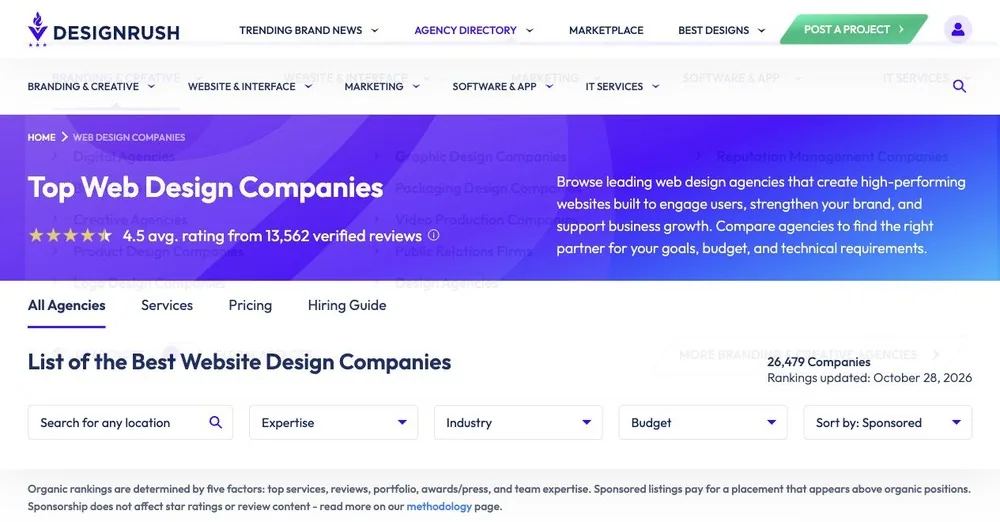
International directories of web studios are convenient for this. One of the largest is Designrush: its web design section lists more than 26,000 companies and 13,500 verified reviews with an average rating of 4.5. Studios can be filtered by service, industry, budget and city.
How to use the directory:
- look at the ranking: a company's place in the list depends on five things: services, reviews, portfolio, awards and publications, and the team. Paid placements are marked and appear above the rest;
- open the portfolio and look for projects in your industry;
- read reviews in full, not just the rating;
- pay attention to badges: "Verified" means the company has been checked by the directory team, "AI Leader" indicates visibility in AI search, and "Award Winner" indicates a design award.
RM Systems is also listed in the Designrush directory: you can see the studio's work there and compare it with others.
Trust as the main advantage: escrow, documents, an open construction site
In construction, legal transparency works as advertising.

Escrow. Since 1 March 2025, Federal Law 186-FZ on building private houses under construction contracts using escrow accounts has been in force. The client's money is held in a bank and frozen until construction is complete, and the contractor receives it after the ownership of the house is registered. The funds are insured by the state up to RUB 10 million. Escrow gives access to subsidised mortgages and maternity capital.
For the contractor this is harder: you have to build with your own or borrowed money. But for the client it is the strongest argument. If you work with escrow and are accredited by banks, say so in large letters: on the website, in listings and in ads.
Documents. An official contract, a transparent estimate with a breakdown of work, a legal entity with a history, SRO membership for commercial projects. Clients are put off by exactly the opposite: a "from-to" price without a list of work, a request to pay in cash without a contract, no office, no legal entity. And promises to "build 50% cheaper than the market": nobody believes such a discount.
An open construction site. Photo reports by stage, videos from the site, an invitation to visit an active construction site. A contractor who is not afraid to show the process looks more reliable than one who shows only finished facades.
Reviews. Recent, with photos, with replies from the company. A negative review with a polite reply and a solution to the problem inspires more trust than a perfect five without a single complaint.
Response speed: whoever replies first gets to build
The most underrated part of promotion. A company pays several thousand roubles for an enquiry, and then the manager calls back three hours later. By that time the client has already spoken to two competitors.
American research on the renovation and home services market agrees on one thing: most clients, up to 78% according to various sources, sign a contract with whoever replied first.
What to do about it:
- The first-minutes rule. Enquiries are processed immediately, not "when a manager is free".
- A bot on the website and in messengers. It replies instantly, day and night, asks three or four questions (what are we building, where is the plot, when are you planning, what is the budget) and passes a ready enquiry to the manager. The client gets an answer right away, and the manager calls already prepared.
- Answers based on your materials. An AI assistant trained on your projects, prices and technologies will answer the question "why is aerated concrete better than a timber frame" the way your engineer would.
- Follow-ups. The deal cycle in construction is long. A client who said "we'll think about it" may be ready a month later if you have reminded them of yourself: sent a house design, invited them to a site, shared a photo report.
At RM Systems a Telegram or MAX bot starts at RUB 15,000, and an AI assistant that answers from the company's knowledge base starts at RUB 20,000.
The law: what to check before launching ads
- Ad labelling. Every advertisement, banner and promotional post must carry the "Advertisement" label, the advertiser's name and a token obtained through an advertising data operator. Fines for companies reach RUB 500,000.
- Personal data. If the website has an enquiry form or a calculator, you need consent to data processing (the client ticks the box themselves), a privacy policy and data storage on servers in Russia.
- Company details on the website. The full company name, address, INN and OGRN.
- SRO. For commercial and large projects, you will not be admitted to a tender without it.
The full list of what websites are fined for is collected in the article Website fines in 2026.
How to tell whether advertising pays off
Agencies like to report clicks and the number of enquiries. But a construction business owner cares about something else: how much one signed contract cost.
A cheap enquiry often turns out to be empty. According to industry data, only about a third of calls from advertising in this niche are relevant: the rest ask about the wrong thing, in the wrong place, or "just want to know the price".
An illustrative calculation based on the figures from the Russian case study:
- a budget of RUB 320,000 a month, 85 enquiries at RUB 3,765 each;
- about a third of them are relevant, roughly 30;
- about 10 reach a meeting or a site visit;
- 2 sign a contract.
One contract cost RUB 160,000. That sounds like a lot until you remember that the house costs RUB 7 million: it is about 2.3% of the total. Now imagine the manager called back slowly and only one client signed. The cost of a contract doubles, even though the advertising is the same.
That is why you should look at the whole chain: enquiries, relevant enquiries, meetings, contracts, revenue. And calculate at which step people are lost.
How to choose a marketing contractor
Warning signs:
- a guarantee of reaching the top of search results in one or two weeks;
- a promise of enquiries many times cheaper than the market: often these are fake clicks or fake enquiries;
- a refusal to give access to the ad account and Metrica;
- a request to transfer the advertising budget to the agency's personal accounts;
- no experience in construction: such contractors waste the budget on irrelevant queries.
What to fix in the contract:
- all digital assets belong to your company from day one: the domain, the website, the ad account, Metrica, social media communities;
- what counts as a relevant enquiry: the right region, a real budget, a confirmed need;
- weekly reports: spending, cost per enquiry, share of relevant enquiries;
- realistic deadlines: launching ads in one or two weeks, results from search engine promotion in three to six months.
Where to start: a plan for the first three months
- Listings in Yandex Maps and 2GIS. Services, areas of work, real photos of projects, asking past clients to leave a review.
- A website that removes fears. A detailed portfolio, "from" prices, documents, the team, a phone number in plain sight.
- A fast reply. The first-minutes rule and a bot that accepts enquiries around the clock.
- One fast channel. Direct or Avito with a clear budget and tracking of the cost per contract rather than per enquiry.
- Industry platforms. Stroim.dom.rf for private houses, ratings and local directories.
- Construction from the inside. A weekly photo report on social networks or Telegram.
- Long-term channels. In two or three months, when the basics are working: blog articles, videos, website promotion, partners.
Frequently asked questions
Is word of mouth enough?
For a small crew in its own area, it is sometimes enough. But a recommendation will still be checked online, so a map listing, reviews and a simple website with photos of projects are needed even by those who work only through acquaintances.
Where to start if the budget is small?
With what is free: listings in Yandex Maps and 2GIS, reviews from past clients, photos of projects. Then an inexpensive website with a portfolio and prices and platforms such as Avito or Profi. Connect Direct when the website is ready and enquiries are handled quickly.
Do you need a website if enquiries come from Avito?
Yes. A person from Avito almost always checks the company further: looks for the website, reviews, documents. A website also protects you from depending on a single platform: if Avito's rules change or listings become more expensive, clients will keep finding you.
The bottom line
Clients of a construction company are not looking for the lowest price but for the most reliable contractor. The internet is needed to show that reliability.
Fast channels such as Direct and Avito keep crews busy now. Maps, the website, ratings and content accumulate trust and reduce the cost of a client over time. Directories and ratings in your industry add one more place where you are found and checked. And all of it works only if enquiries are answered in minutes rather than hours.
Start with what is checked first: map listings, reviews and a website that shows real projects, prices and documents.
A website and a bot for a construction company: a multi-page website with a portfolio, house designs, prices and a calculator, promotion in search and AI search, and a Telegram and MAX bot that accepts enquiries around the clock. See multi-page websites and Telegram and MAX bots and Mini Apps for details, or contact Roman Mikhaylov, developer.