
Morning. You wake up with a dream still clinging to the edge of your awareness: a house with unfamiliar rooms, water, someone’s voice. In a minute it will start to fade. In an hour, only the strange feeling you woke with will remain, and the question: what was it about?
People have tried to understand their dreams for more than three thousand years. Egyptians recorded interpretations on papyrus. Pushkin’s Tatyana kept Martyn Zadeka’s dream book under her pillow. Today, someone searches for “what does water in a dream mean” and finds twenty websites where the same water promises illness, wealth or tears.
The Path of Dreams AI dream interpreter grew from a simple idea: a dream should not frighten you. Every dream and every day can contain something good: a hint, an opportunity, a reason for joy. A small world has formed around that idea:
- Dreams, where you can describe a dream in your own words and receive an interpretation without alarming verdicts;
- Luck, a daily three-card spread from a deck of seventy-two cards;
- Anger Sheet, a page for writing out your anger and receiving a calm response;
- Diary, one page for each day that brings everything together;
- Blog, with articles about dreams and signs of good luck.
It all works on pathofdreams.online in Russian and English, through Telegram and MAX bots, and in a Mini App inside both messengers. Below is how each part works, followed by what any business can borrow from the project.
The idea: an online dream interpreter that does not frighten you
Conventional dream books work like dictionaries: a symbol followed by a verdict. A snake means betrayal, teeth mean death, an ex means an argument. Someone arrives with an unsettling dream and leaves more anxious.
I wanted the opposite: a companion who hears the whole dream, including feelings and small details, and helps find meaning useful today. An attentive friend who has read widely about dreams.
The difference is simple. A dictionary answers “what does a house mean?” A companion answers “what does my house mean in my dream?”
A second idea soon followed: a small morning ritual. Something like a card of the day, using an original warm, fairy-tale deck rather than ominous Tarot.
The third idea came from life. Some days leave no room for dreams or luck: anger boils inside or anxiety weighs you down. The Anger Sheet was created for those days.
The Diary then brought dreams, cards and supportive words for a single day together in one place.
AI dream interpretation in your own words
The homepage has one field and an “Interpret my dream” button. No questionnaires, birth dates or zodiac signs. Describe the dream as you would to a friend over breakfast: the whole story, one image or simply the feeling left after waking.
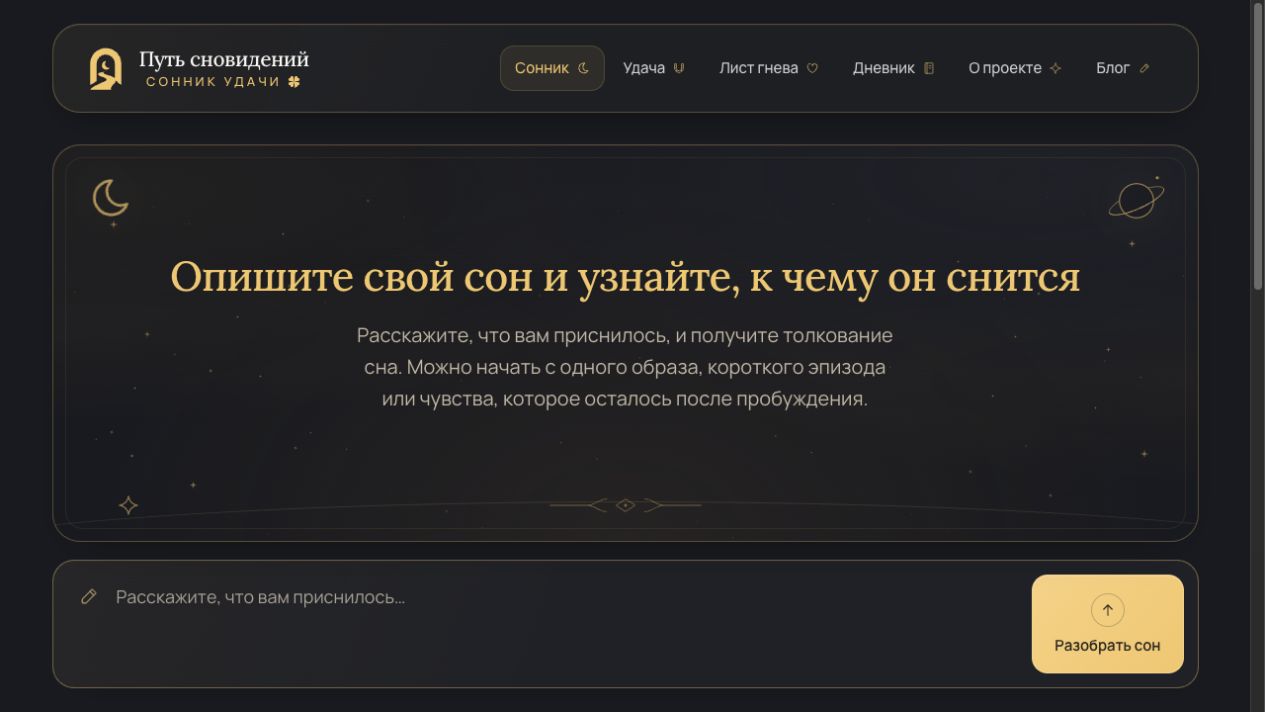
How AI interprets a dream
The interpretation arrives immediately, without follow-up questions. It begins with a “dream map”: a short title and a couple of sentences about the main theme. Several brief sections follow:
- The dream’s main feeling. Fear, curiosity, confusion or joy. The interpretation starts here because the same story can mean different things depending on how you felt.
- Significant details. Possible meanings of images in your account. A symbol offers a possible personal meaning. For one person, water suggests cleansing; for another, overwhelming emotions. Your words help distinguish them.
- A thought for today. One idea or question to carry into the day.
The interpreter uses what you described without inventing events absent from the dream. It gives no lucky numbers, guarantees or medical advice. And it does not frighten you.
An example dream interpretation
Someone described a quiet lake under the moon and a boat found on its shore. They felt calm, curious and delighted by the discovery. Here is the beginning of a real response:
A quiet lake and a boat to the other shore
A dream of a calm lake beneath the moon and a discovered boat speaks of inner balance and readiness to explore new sides of life. Delight at the discovery symbolises openness to change, while the other shore represents unexplored opportunities. It is a sign to trust your curiosity and move gently towards something new.
The dream’s main feeling. The calm and curiosity you experienced are the key to understanding it. The lake beneath the moon reflects a steady emotional state, without anxiety or agitation. The moon adds a sense of intuitive exploration, as though the subconscious were illuminating the way. Joy at finding the boat suggests you are ready to act, without hurry or fear.
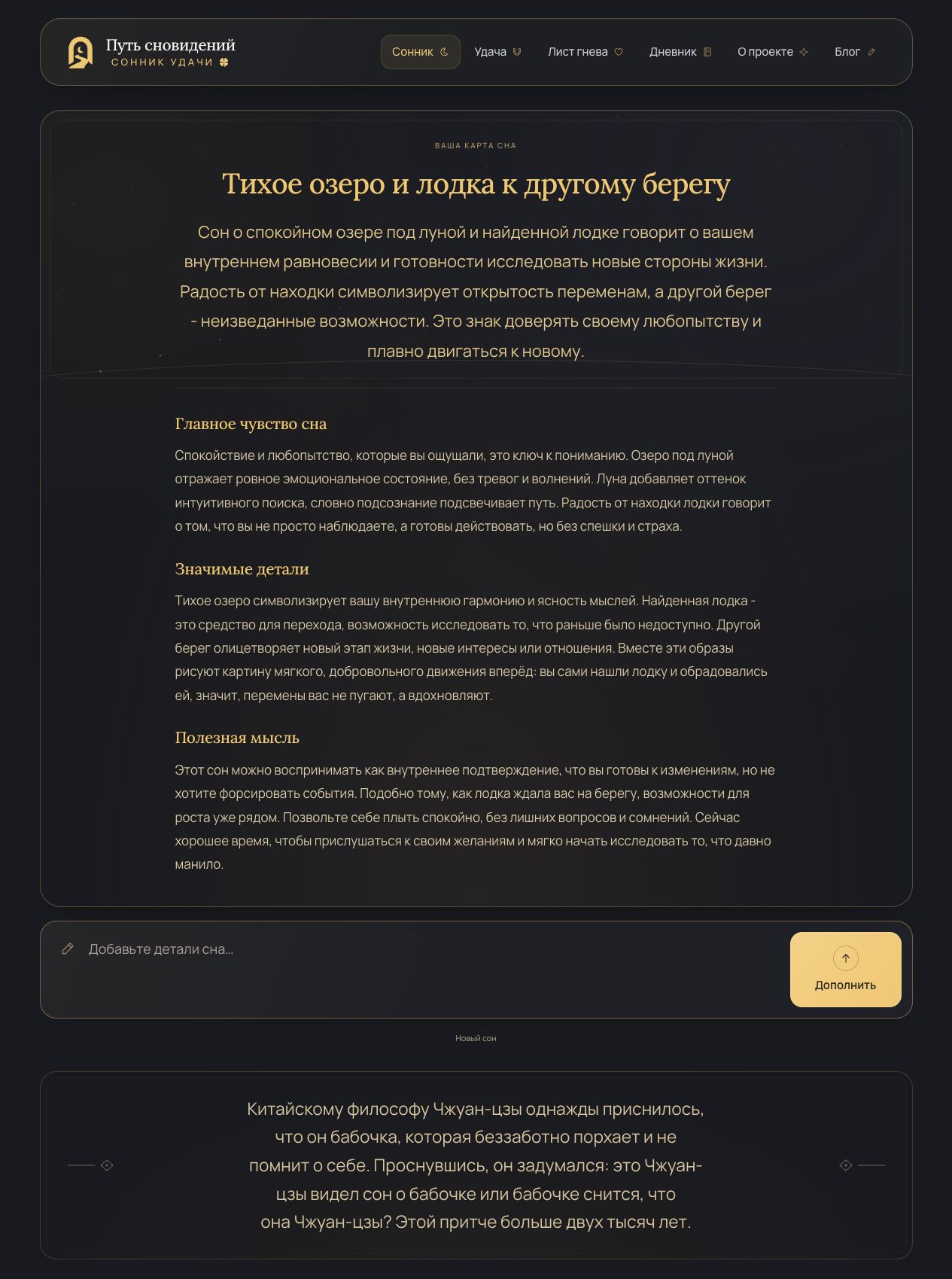
You can ask more
After the response, ask “why was the boat empty?”, “what does the old house mean?” or “why couldn’t I run away?” The interpreter remembers today’s dream and continues the conversation. Follow-up answers are shorter and focus on the detail that stayed with you.
Where its knowledge of dreams comes from
Behind the answers is a library about dreams: articles, a dictionary of common symbols, folk dream books, including Martyn Zadeka’s from Eugene Onegin, Miller’s dream book, psychological ideas and scientific knowledge about sleep.
Think of a librarian with a good memory. You describe a dream, the system finds the library pages closest to your account, and the answer draws on them. This makes responses more specific. As the library grows, the interpretations become more precise.

Recording a dream for a more useful interpretation
- Immediately after waking. Dreams fade within minutes. Capture at least a few words before the details disappear.
- Include feelings as well as events. Fear, joy, surprise and confusion can reveal more than the plot.
- Small details that stood out. A colour, sound, unfamiliar face or strange inscription.
- A little life context, if you wish. A recent conversation, event or worry. Dream images often resemble something familiar from waking life.
Many visitors bring familiar themes: a deceased relative, falling teeth, an ex-partner, water, a snake, an exam or a chase. An unsettling dream they want reassurance about, or a vivid one they do not want to forget.
Online luck cards: three cards for today
Morning, a cup of coffee and three face-down cards. The dark card backs carry Sun and Moon ornaments. Above them are three labels: Character, Path and Sign. Press one button and the cards turn over.
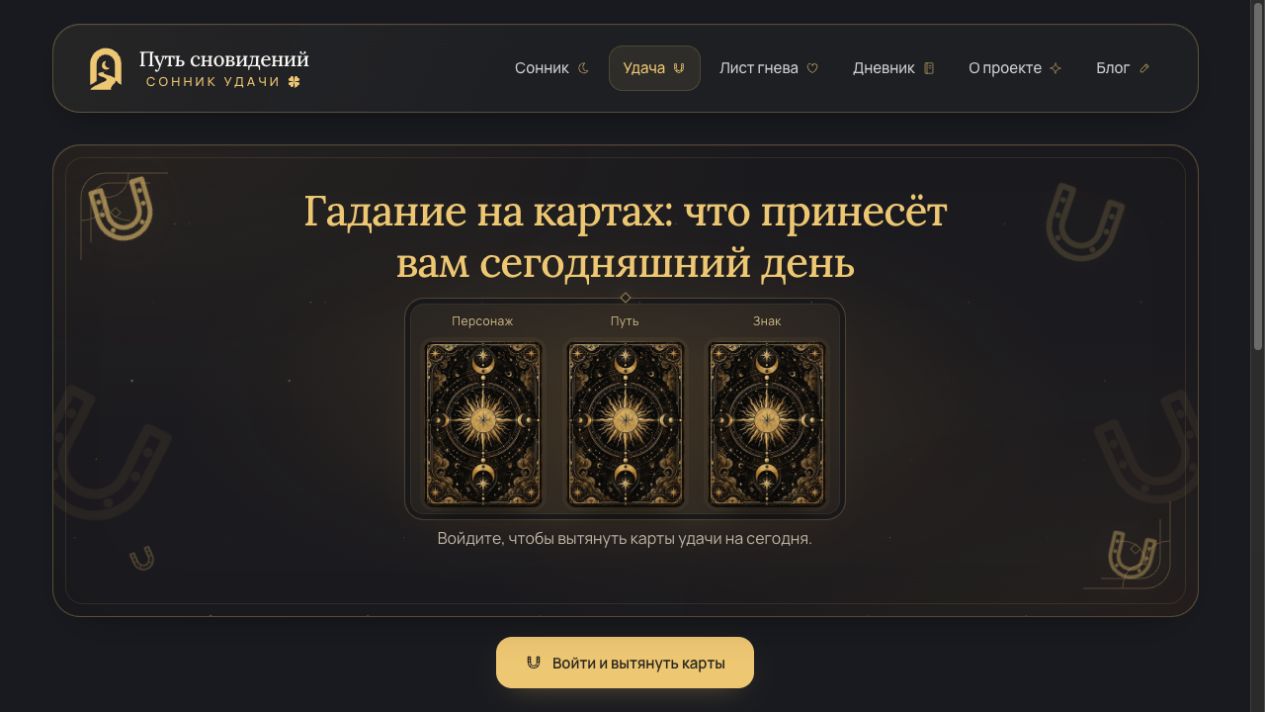
How the spread works
Sign in through the Telegram or MAX bot with one tap, think of a question or simply focus on the day, then reveal the cards. Any of the seventy-two cards can occupy any position. A horseshoe rating appears above them, and AI combines the three into one connected suggestion for today.
Character, Path and Sign: position gives meaning
The central idea is that a card has more than one meaning. Its position determines how it is read.
- Character describes who you are today: your strongest quality and what you can rely on.
- Path suggests one small, manageable action.
- Sign draws attention to something around you: an object, a sound or an encounter.
Together they form a short story of the day: who you are, where to go and what to notice on the way.
Each card therefore has three meanings, one for each position. A familiar card can say something different on another day, depending on where it lands. Consider the card with the key “Inner Fire”:
- in the Character position: today your inner fire is stronger than your doubts;
- in the Path position: take the first step on something you have long postponed;
- in the Sign position: fire, a spark or a sudden surge of energy.
Who appears on that card and how many horseshoes it carries can remain a surprise. Discovering it in a spread is more interesting that way.
Horseshoes: the strength of a hint, not a prediction
Each card has a row of horseshoes with their open ends upwards, so luck does not spill out. There are one to five, and the day’s rating combines the horseshoes on all three cards.
Horseshoes do not predict success or measure its probability. They show how strongly the day’s hint is expressed.
An example daily spread
Suppose the cards suggest Character “determination”, Path “put small things in order” and Sign “an unexpected encounter”. AI might connect them like this:
Order begins with something small
Today you have enough determination to stop putting things off. Direct it towards the small tasks that have been waiting for attention.
Determination and order complement each other: finishing one small task clears space for a larger one. An unexpected encounter or conversation may suggest where to begin.
Today’s step: choose one small task that has been waiting for more than a week and finish it before lunch. Be open to a conversation that begins unexpectedly.
The first paragraph reads all three cards together, the second explains their connection, and the third offers one step for today.
Why there is only one spread per day
There is one spread a day, deliberately without a “draw again” button. A hint keeps its value while you resist repeatedly drawing until the result is convenient. Drawing until something agreeable appears removes the point.
There is always tomorrow. In the evening, you can reflect on whether you encountered the Sign. It may appear or it may not, but the small, manageable step in the third paragraph remains useful.
The luck deck: seventy-two cards in five series
The Path of Dreams deck was illustrated from scratch. Seventy-two cards, seventy-two characters, each with a small scene and an action. The dimensional fairy-tale style resembles an animated film, with one coherent visual language across the deck.
Five series
The frame and horseshoe colours indicate the card’s level:
- silver, one horseshoe: small pleasures and quiet everyday luck;
- emerald, two horseshoes: first steps and courage;
- sapphire, three horseshoes: masters and eccentrics;
- ruby, four horseshoes: magical helpers;
- gold, five horseshoes: great forces of good fortune.
The characters come from tales, myths and traditions around the world. Some are familiar, others magical or powerful. Some are usually considered frightening. It is more enjoyable to discover them through the cards.
The website does not reveal whether silver and gold appear equally often. Discovering the pattern day by day is part of the game.
A collection that gathers itself
Opening cards every day lets you see the whole deck in roughly four months. Repeats mean the first new cards arrive quickly, while the last unfamiliar ones take longest. Each new discovery near the end feels like a small event.
There is nothing special to collect: the collection forms naturally, morning after morning.
The online Anger Sheet: write out anger and settle down
Sometimes anger has nowhere to go: a manager, a relative, a queue or an injustice. Saying it aloud feels impossible, but keeping it inside is difficult.
The Anger Sheet is an empty page where you can write things as they are, without carefully choosing words or fearing judgement.

What comes back
A careful listener responds in three steps:
- Acknowledgement. First it reflects what you feel in its own words: “it makes sense that this hurt”.
- Support. Gently, without judging or deciding who is right.
- One small step. Something realistic and immediately available: drink water, step outside for five minutes or leave a difficult conversation until morning.
If more comes to mind afterwards, you can add to the entry.
An example response
An entry might say: “I spent all day on a report, and in the meeting my manager said nobody needed it. In front of everyone. I want to slam the door.”
The response could begin: “A whole day’s work was dismissed by one sentence in front of everyone. Your anger makes sense: it hurt your effort as well as the report…” Support and a small step follow: say nothing today, then write down three questions this evening to discuss calmly with the manager tomorrow.
Why writing anger down helps
There is research behind it. In the 1980s, psychologist James Pennebaker showed how writing about experiences can help process them. Japanese researchers reported in 2024 that anger declined markedly when people wrote it down on paper and threw the paper away.
Sometimes another need hides behind anger. HALT names four states: hunger, anger, loneliness and tiredness. When anger is already present, check the other three. Sometimes food or an earlier night makes the world bearable again.
An honest boundary
The Anger Sheet clearly states that it does not replace a psychologist. If distress has lasted a long time, seek help from a psychologist or doctor. It offers support rather than therapy, and can be there on a difficult evening.
The dream and luck Diary: one page for the day
The Diary brings the day together: a horseshoe luck rating, three revealed cards, the daily phrase, your dream, the day’s hint and supportive words. Below is the previous card combination for comparison.
The daily phrase changes each day, staying warm and brief: “Luck gathers like light in a window, one drop each day. Today’s drop is already yours.” Or: “Today is the best time to begin. Yesterday’s cards have played their part; today’s are waiting.”
Reveal cards and record a dream in the morning; return to the Diary in the evening and recall whether the Sign appeared. The interpreter and cards become a small habit.
Enter the Diary through the Telegram or MAX bot with one tap, without passwords or codes.
Quotes and stories about dreams, luck and anger
Beneath each section’s button is golden text: a quotation or a short story, different each time the page opens. Every story was selected manually and checked against its original source; none is invented.
The Dreams page tells how Paul McCartney dreamed the melody of “Yesterday”, played it on the piano after waking, then spent around a month asking musicians whether they had heard it before: he did not believe he had written it. Pharmacologist Otto Loewi dreamed an experiment that later earned him a Nobel Prize. Violinist Tartini dreamed of a devil playing the violin, inspiring the Devil’s Trill Sonata. Keith Richards devised the “Satisfaction” riff while barely awake and recorded it on tape: the morning’s recording contained a couple of minutes of guitar followed by roughly forty minutes of snoring.
The Luck page includes Pasteur’s observation that chance favours a prepared mind. Psychologist Richard Wiseman gave people a newspaper and asked them to count its photographs. A large notice inside already supplied the answer. People who considered themselves lucky noticed it more often. Luck can mean noticing your surroundings, which is why every spread includes a Sign. There is also the old Chinese tale of a man whose horse ran away: when neighbours offered sympathy, he replied that nobody yet knew whether it was misfortune or good luck.
The Anger Sheet shares Seneca’s advice that delay is the best remedy for anger. Jefferson’s rule suggests counting to ten before speaking when angry, or to a hundred when very angry. It also tells of Lincoln’s angry letter to General Meade, written but never sent.
You may want to open a page again simply to discover which story appears next.
Dreams in Telegram and MAX: bots and a Mini App
You can also message the Telegram or MAX bot. A button opens the Mini App inside the messenger with five tabs: Dreams, Luck, Anger Sheet, Diary and Profile. Profile explains the project, the cards and how to support it.
No separate registration is needed: the messenger verifies who you are. It is the same account as the website, sharing the Diary, cards and history. Start on your phone in the morning and continue on a computer in the evening.
I also described running one service in two messengers in the KupiSpisok shared shopping list case.
The dream blog: articles for people and the interpreter
The blog contains eleven Russian and English articles about common questions: deceased relatives, falling teeth, former partners, animals and pregnancy in dreams; settling down after a nightmare; differences between Miller, Vanga, Freud and Juno dream books; and luck traditions around the world.
Each article works twice:
- for a person: a search question leads to an article, then the relevant section. Dream articles lead to Dreams, luck traditions to Luck, and unsettling dream articles to the Anger Sheet;
- for the interpreter: those same articles enrich its library and make interpretations more precise.
More articles make the interpreter more knowledgeable. The same work brings people from search and improves the answers.
How Path of Dreams was built
I am Roman Mikhaylov, the developer behind RM Systems. Path of Dreams was created as a working showcase: demonstrating the studio’s capabilities in a product people use every day. The project launched on 24 October 2026.
In plain language
The project has three parts:
- The website. What visitors see in the browser: Dreams, Luck, Anger Sheet, Diary and a Russian and English blog. People find it through ordinary and AI search for dream meanings, online dream interpretation and online luck cards.
- The library and AI. Dream articles and dictionaries live in a vector database, like a library organised by meaning. Describe “floating in a boat on dark water”, and it finds material about water, boats and night even when the wording differs. AI receives those pages and bases its answer on them.
- The bots and Mini App. The same project inside Telegram and MAX, with one-tap sign-in and a Diary shared with the website.
The owner also has YooKassa payments and an administration area for managing participants, payments, AI material and library articles without a programmer.
What an AI answer costs
One interpretation costs roughly two kopecks. The model itself is inexpensive; most work surrounds it: building a useful library, guiding the AI towards thoughtful, relevant answers and making the answer one tap away.
What a business can borrow
If you thought “I want something like this for my own field”, the showcase has done its job. Dreams and luck cards are an example of techniques that apply elsewhere:
- AI using your material. As the interpreter draws on its library, a salon bot can use prices and booking information, a school bot can explain course material, and a company bot can answer staff questions from instructions.
- A considerate response to emotions. The Anger Sheet’s sequence of acknowledgement, support and a next step suits customer complaints: AI reduces the initial intensity and passes the enquiry to a manager.
- A daily ritual. One spread a day encourages a return tomorrow. A shop might offer a daily tip or bonus through its bot.
- A collection that builds itself. Like the seventy-two-card deck: bonuses, achievements or a loyalty card.
- Messenger sign-in. Fewer people abandon the journey when passwords and registration forms are unnecessary.
- Articles doing two jobs. They attract search visitors while improving the bot’s answers.
RM Systems starting prices are RUB 15,000 for a Telegram or MAX bot, RUB 20,000 for AI answers using company knowledge, RUB 30,000 for a Mini App and RUB 60,000 for a multi-page website. The total depends on the sections and integrations your project needs.
Frequently asked questions about the AI dream interpreter
Does the interpreter predict the future?
No. Interpretations and cards offer suggestions. The interpreter helps identify possible personal meanings, while cards provide a mood and one small step for the day. Decisions remain yours.
Do I need to register?
No password is required. One dream a day can be interpreted without signing in. Luck, Anger Sheet and Diary need only one-tap sign-in through Telegram or MAX.
Can I draw the cards again?
No. There is one spread per day. Returning shows the same spread; new cards wait until tomorrow.
Is it free?
Yes. You can support the project with any amount on the About page. As a thank-you, Premium provides more detailed answers and a higher daily request limit.
Can you build a similar project for my business?
Yes. A website, AI using your material, bots, a Mini App, payments and administration can be combined around booking, a catalogue, training or customer questions.
Conclusion
A dream fades in a minute if you do not record it. Luck passes by if you do not notice your surroundings. Anger stays inside if it has nowhere to go.
Path of Dreams offers three small actions: record a dream, reveal cards and write out anger. Everything is designed to make each one a one-minute, one-tap activity.
Try it tomorrow morning: describe your dream, reveal three cards, or open the Telegram or MAX bot. Your dream may have more to say than it seems. And nobody knows which card will appear first.
A website, AI and bots for your business: a website with SEO and GEO for search engines and AI, an assistant using your knowledge base, Telegram and MAX bots and Mini Apps, payments and administration without a programmer. See multi-page websites, Telegram and MAX bots and Mini Apps and custom software development, or contact Roman Mikhaylov, developer.