
A client can like an interior rendering and still be unsure about hiring the studio. A full project involves months of decisions about budget, materials, schedules and what happens on site. To sell design, site supervision and procurement together, show buyers how your team takes a brief through to a completed interior. Give them enough information to choose a scope and know what they will receive.
Start with the economics of a signed project
Follow the path from an enquiry to a paid engagement. A studio might spend RUB 140,000 on ads and RUB 60,000 on campaign management in a month. If that produces 100 enquiries, 20 meetings and five contracts, acquisition costs RUB 40,000 per contract. The cost of an enquiry gives a different picture from that of the signed project.
Plan the work as distinct services. Charge for the design package in milestones with defined deliverables. Quote site visits and design decisions during construction separately from the contractor's responsibility for carrying out the work. Explain what procurement includes, who approves suppliers and which party handles payments, warranties and replacements.
Here is an illustrative comparison for a 90 m² property. The procurement fee uses a base of RUB 5.5 million. Both scenarios assume the same acquisition cost.
| Measure | Design package | Design, site supervision and procurement |
|---|---|---|
| Design at RUB 4,000 per m² | RUB 360,000 | RUB 360,000 |
| Site supervision over ten months | None | RUB 550,000 |
| Procurement service fee at 8% of the base | None | RUB 440,000 |
| Total studio revenue | RUB 360,000 | RUB 1,350,000 |
| Direct team costs | RUB 175,000 | RUB 495,000 |
| Tax and operating reserve in the example | RUB 36,000 | RUB 96,000 |
| Acquisition cost | RUB 40,000 | RUB 40,000 |
| Balance after the listed costs | RUB 109,000 | RUB 719,000 |
The full engagement spans a longer period and requires additional capacity. Schedule payments around the delivery milestones and compare the balance with the team time involved. A fixed fee suits a clear scope. Billing by area helps customers estimate a design package. Charging by time can work for exploratory changes. A recurring flat fee or a disclosed percentage can work for procurement if the scope, base and expenses are clear.
Make the budget, contract and procurement clear
Show what is included and what could change
Separate the studio fee from building work, materials, furniture and logistics. Give customers a range and state which assumptions you used. Maintain a planned and actual budget as work proceeds. Agree when a spending change requires approval, and keep a reserve suited to the uncertainties of the project.
Define what the studio will check on site and what the construction team must do. A milestone needs a clear version of the work and a record of approval. Agree which documents or decisions the client needs to provide and when. If the site or brief changes, show the effect on cost and time before resuming work.
Make supplier terms visible
Show the agreed cost of sourcing and coordination, who invoices the customer and how you handle supplier discounts or commissions. For major items, compare supplier options on a consistent basis. List availability, lead times, delivery, installation and support. Keep a record of the agreed specification and approved substitute when a material is unavailable.
In the budget example above, an 18% supplier discount off RUB 5.5 million is RUB 990,000. Deducting a disclosed fee of RUB 440,000 calculated on the same base would leave an illustrative saving of RUB 550,000. Use real quotations and the actual fee base to show the value in each project.
Cover five points in the agreement
- List the plans, drawings, specifications and schedules the studio will deliver.
- Set out sourcing fees, third-party costs, approval steps and responsibility for returns.
- Agree the number and timing of review rounds. Explain how additional work is approved.
- Confirm the schedule and which decisions, access and building conditions it depends on.
- Specify the file formats and use rights. Agree whether PDFs, editable DWG or IFC files, or other material will be handed over, and when.

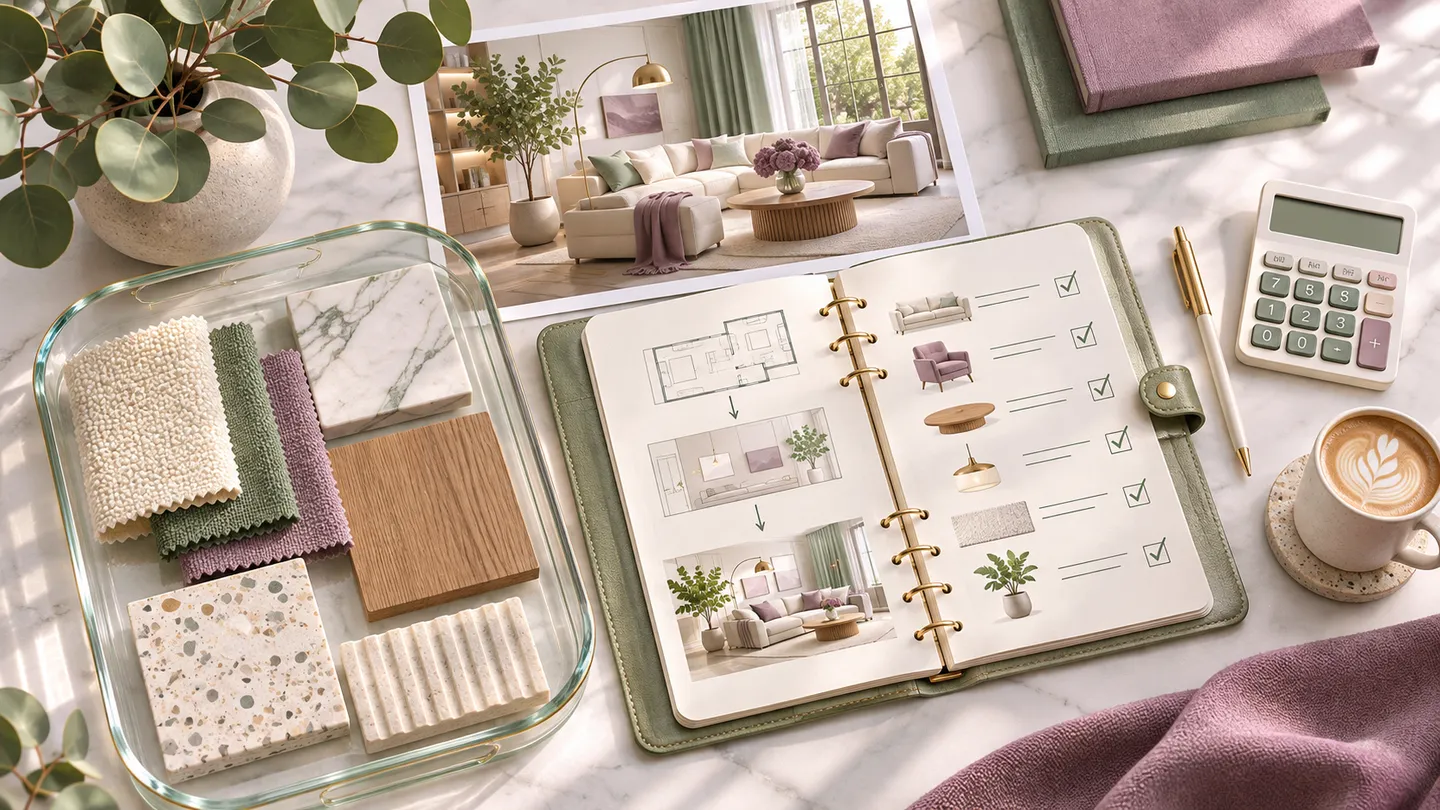
Publish a portfolio that shows how the job was done
A good case study identifies the original problem and shows what you delivered. Pair a rendering with a finished photograph when you have both and label the stages. Add area, timescale and the relevant scope. Tell readers how the design changed to suit a structural or engineering constraint. Show excerpts from drawings or schedules where you have permission. Add a relevant client comment and photos of the work. A project still on site can show construction progress and details that have been completed.
For a landing page aimed at a particular development, open with the property type, the offer and an indicative price basis. Include a local example, the project stages, the key budget variables and a way to send a floor plan or book a discussion. Show how design, site supervision and procurement can be combined. Portfolio site for a decoration studio · How to increase website conversions


Pick acquisition channels for the work you want
| Channel | What it can do | What to count |
|---|---|---|
| Search advertising | Reach people searching for design in a specific development, area or property type | Cost per viable brief, meeting and signed engagement |
| Maps and local directories | Help an owner confirm the location, contact details and reviews | Visits to relevant project pages and appointments |
| Telegram and other social channels | Show current work and give interested clients somewhere to start a brief | Complete briefs, appointments and contract value |
| Organic search | Help prospective clients find answers about scope, budget and property constraints | Enquiries tied to project pages and guides |
| Pinterest and visual platforms | Give the studio's work a route to people collecting ideas | Visits to the original case and useful requests |
| Listing marketplaces | Test demand for a clearly scoped introductory service | Paid projects and margin after fees and staff time |
| Developers, builders and brokers | Meet clients while they choose a property or plan a renovation | Referred meetings, qualified projects and signed contracts |
Choose a handful of developments with a realistic flow of potential projects and a brief your studio can serve. Create pages that add something specific, such as a sample design decision or a typical constraint from the building documentation. Pair search ads with those pages and mark the lead source in the CRM. Renovation marketing and landing pages
Keep local profiles accurate and ask past clients for honest reviews. From a site visit, make a brief record of a decision, a problem you solved and one or two details you can share. With permission, reuse that material as a case update, photo set or short video. Link the posts back to a project page with the full context.


Use Telegram and MAX for the brief and handover
Ask for the type of property, area, location, scope, budget range, preferred timing and any plan the client can share. Send the brief to the CRM along with the original channel. Offer a next step and assign someone to follow up. A chatbot can collect initial details and a member of the team can review the constraints, price assumptions and feasibility.
The Goskey bot in MAX can transfer a document for signature in Goskey after the required profile verification. Agree with the client how the relevant documents will be accepted and signed. Check the signature requirements and keep the signed record linked to the actual package and version accepted. MAX instructions for signing documents · MAX for business
Turn a first meeting into a well-scoped project
Use a first conversation to discuss the brief, a relevant portfolio, your scope and the approximate budget. When a visit requires measurements, engineering review or initial layout work, offer it as a paid feasibility assessment with a written output. Some studios credit the assessment fee against subsequent design work if the parties agree on the terms.
Give brokers, builders and property managers a clear description of what you can check before purchase or renovation. A short technical assessment can identify a need for structural review, access limitations or a mismatch between the desired layout and service routes. Explain what you can answer from the available information and when a specialist survey is needed. A capability statement with real documentation and contact details helps construction partners decide when to refer you. How construction companies find clients

A 90-day plan
| Period | What to prepare | What to check |
|---|---|---|
| Month 1 | Publish project cases and define design, site supervision and procurement scopes. Make price assumptions and handover rules visible. | Quality of incoming briefs and what prospects still ask before a meeting |
| Month 2 | Launch campaigns for a small set of developments and connect the intake form or bot to the CRM. Collect genuine reviews and link them to relevant project pages. | Cost per qualified meeting and where enquiries drop out |
| Month 3 | Test a paid feasibility assessment and build a referral process with suitable partners. Review scope and fees on recent contracts. | Cost per contract, cash flow across milestones and contribution per project |
Common questions
How can a studio charge for procurement when clients can buy the products themselves?
Show the work involved in selecting compatible products, checking the orders, coordinating delivery and resolving defects or delays. Let the customer choose the level of help and see the service fee before approving purchases.
When should a studio charge for a first site visit?
A free conversation can establish whether the studio serves the project. A visit with measurements, a constraint review and written recommendations is a distinct service. State the price and deliverables and tell the customer whether any credit applies to a later agreement.
Why add MAX if a studio already uses Telegram?
It gives clients another way to send a brief and discuss a project. Add it if the audience uses it and the team can manage the conversation. Keep approvals, decisions and files attached to the same project record.
RM Systems builds landing pages, portfolio and multi-page websites and business bots for briefs and customer communication. Roman Mikhaylov, developer